THE MOST WATCHED SHOW ON NOVA.CZ IS LOVE ISLAND

On the Nova.cz website, they accounted for more than a third of all reality show views last year. Of these, Love Island is the most watched, followed by Bachelor.

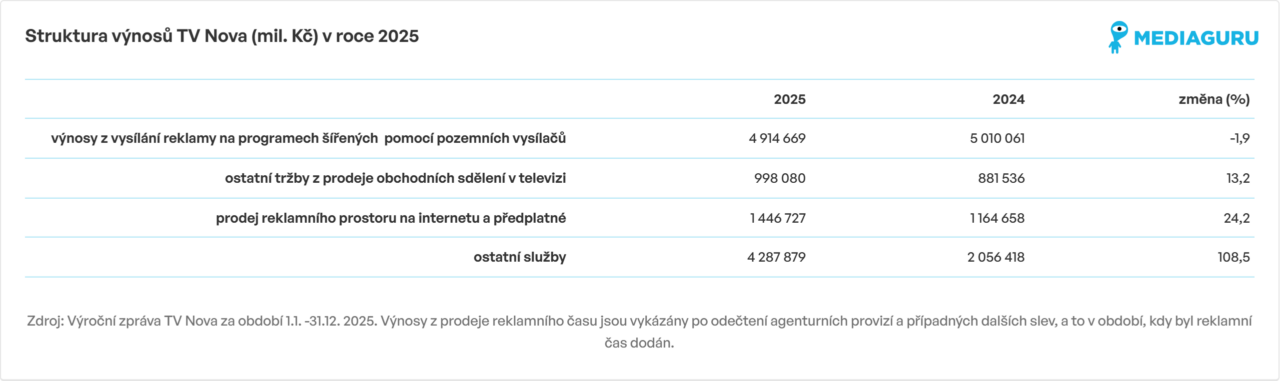
Video content on the Nova Group’ s online platforms reached hundreds of millions of views during 2025. A total of 72.46 million video views were recorded across tv.nova.cz, HbbTV and mobile apps. Of this volume, 25.26 million views were of reality shows, which accounted for approximately 35 percent of the total viewership of video content on this platform.

The most watched programmes on tv.nova.cz were mainly reality formats. Love Island reached 6.40 million views, Bachelor recorded 5.28 million plays, Survivor 5.25 million and Extreme Makeover 4.11 million views.

The news website TN.cz reported an even higher volume of video content. In total, 233.08 million video views were recorded, with an additional 362.76 thousand views via HbbTV. A separate category was sports videos, which reached 10.38 million views on TN.cz.

The Nova Group published the results online as part of its annual balance sheet. It also said that last year’s milestone for it was the launch of Oneplay, the largest streaming service in the Czech Republic, with which viewers spend an average of 5.7 hours a day.

Source: mediaguru.cz

NEW YEAR’S EVE ON TV NOVA, TV PRIMA AND ČT1 MARKED BY SPECIAL PROGRAMS

The largest domestic television stations have prepared special editions of their entertainment programs for the evening of the last day of 2025.

TV Nova will broadcast a special edition of Televizní noviny on New Year’s Eve. The program will offer entertaining content, including appearances by characters from the series Comeback, and will highlight selected moments from the station’s programming.

The broadcast will also include “bloopers” from TV Nova programs and series, as well as examples of slip-ups and failed shots from Televizní noviny. The program will also offer a solemn remembrance of personalities who died during the year.

TV Nova will broadcast New Year’s Eve TN on December 31 at 7:30 p.m. It will be followed by the New Year’s Eve specials Na lovu (8:35 p.m.) and Možné je všechno (9:55 p.m.). After midnight, there will be a concert by Michal David at the O2 Arena to celebrate his 65th birthday.

TV Prima will also feature New Year’s Eve specials of its established programs. Starting at 8:25 p.m., it will first offer a special edition of the program Inkognito and then, at 10:25 p.m., a special edition of Partička.

The main channel of Česká televize also has New Year’s Eve editions of its programs on the schedule. At 7:40 p.m., it will broadcast New Year’s Eve Zázraky přírody, at 8:45 p.m. Všechnopárty, and at 9:40 p.m. a compilation from StarDance Tour… když hvězdy tančí on New Year’s Eve.

New Year’s Eve evening broadcast

ČT1

  • 18:40 Výborná show
  • 19:40 Zázraky přírody
  • 20:45 Všechnopárty
  • 21:40 StarDance Tour… když hvězdy tančí na Silvestra
  • 00:01 New Year’s greetings
  • 00:04 U muziky na Silvestra
  • 00:55 Silvestrovské Banánové rybičky

TV Nova

  • 19:30 New Year’s  Televizní noviny
  • 20:35 Na lovu: Silvestrovský speciál IV
  • 21:55 Možné je všechno! Silvestr
  • 00:00 New Year’s toast
  • 00:02 Michal David i O2 Arena
  • 01:50 The best of Tvoje tvář má známý hlas

TV Prima

  • 18:55 Hlavní zprávy
  • 19:40 Krimi zprávy
  • 19:55 Showtime
  • 20:25 Inkognito – Silvestr 2025
  • 22:25 Prima Partička Silvestr
  • 00:00 New Year’s toast 2026
  • 01:45 Svatá čtveřice

Source: mediaguru.cz

FACT WARNS ILLEGAL STREAMERS FOLLOWING JOINT INVESTIGATION WITH POLICE

The Federation Against Copyright Theft (FACT) has contacted more than 1,000 people across the UK, warning them to stop using illegal TV streaming services or risk prosecution.

FACT said the emails and texts follow investigations carried out with police forces nationwide and form part of its wider effort to raise awareness of the risks linked to unauthorised streaming.

The organisation warned end users they are not anonymous, and said viewers who access illegal streaming services may be liable for criminal offences, including under Section 11 of the Fraud Act 2006.

The campaign follows the recent case of Jonathan Edge, from Liverpool, who was jailed for his role in running an illegal streaming service. Edge was sentenced to 3 years and 4 months in a prosecution supported by FACT and Merseyside Police. FACT said Edge’s own use of the unauthorised service was treated as a separate offence, resulting in a concurrent sentence of 2 years and 3 months, underlining that criminal action can extend beyond suppliers to end users.

FACT said that during investigations into Edge and into operators of another illegal streaming service, police seized customer details from people who had bought access to so-called “loaded” Firesticks, Android or Kodi devices. Those customers have now been contacted directly, warning them of the dangers of continuing to use illegal services.

FACT chairman Kieron Sharp said the campaign was designed to make clear that end users are breaking the law and face “real” risks, including criminal liability, scams, viruses and harmful content, urging people to use legitimate providers.

T/DCI Alethea Fowler of the Tarian Regional Organised Crime Unit said end users face risks including loss of personal data and potential fire hazards, while also funding serious organised crime. She said the unit would continue working with partners including FACT to identify distributors and bring them to justice.

FACT thanked its law enforcement partners, including Merseyside Police, Tarian and the North East Regional Organised Crime Unit, for supporting efforts to tackle wider criminal networks linked to illegal streaming.

Source: broadbandtvnews.com

PARIS COURT ORDERS WIDER LIGUE 1 PIRACY BLOCKS

The Paris Judicial Court has issued 2 rulings in favour of the LFP (French Professional Football League) and LFP Media, extending efforts to block illegal streaming of Ligue 1 and Ligue 2.

The decisions, issued December 18, cover the blocking of websites and IPTV services unlawfully carrying the matches, and also target tools used to bypass ISP restrictions, including VPNs and alternative DNS services.

French regulator Arcom says 66% of internet users who use illegal solutions rely on VPNs or alternative DNS to circumvent blocking measures implemented by internet service providers.

In a first, DNS4EU will be required to implement blocking measures under the court’s orders.

The LFP and LFP Media said the rulings would allow them to broaden their anti-piracy strategy to include a wider set of technical intermediaries involved in the distribution chain, and build on measures already secured against ISPs, certain alternative DNS services and search engines.

They added the approach is designed to protect rights while supporting the legal market for watching Ligue 1 McDonald’s and Ligue 2 BKT, as part of a wider strategy carried out alongside clubs, broadcasters and distributors.

Source: broadbandtvnews.com

PF 2026

The Association of Commercial Television + ScreenVoice wish you a peaceful and relaxing holiday season in the company of the stories and tales you love the most.

Merry Christmas.

TV JANUARY: PREMIERES ON CZECH TV, THE END OF THE SERIES ZOO, THE RETURN OF THE SERIES VYPRÁVĚJ AND CHALUPÁŘI

January will bring only a few premiere shows to TV screens. On the contrary, some more archival titles will return.

January is traditionally a weak season for commercial TV stations, which is why there are few premiere titles on their evening broadcasts. These, on the other hand, will be added to the main programme of Czech TV from the beginning of January. However, ČT1 will also have a lower number of premieres in prime-time next year than in previous years due to previously introduced savings.

The main TV news of the new year will be the show Peče celá země, which starts on Saturday 3 January, and new episodes of the crime drama Místo zločinu Zlín. The opening episode will be offered by ČT on Monday 5 January 2026. The new episodes will be followed by the series Kamarádi (Prima) at the beginning of the year. However, this is basically the end of the list of premieres of dramatic works in the first time window from 20:00.

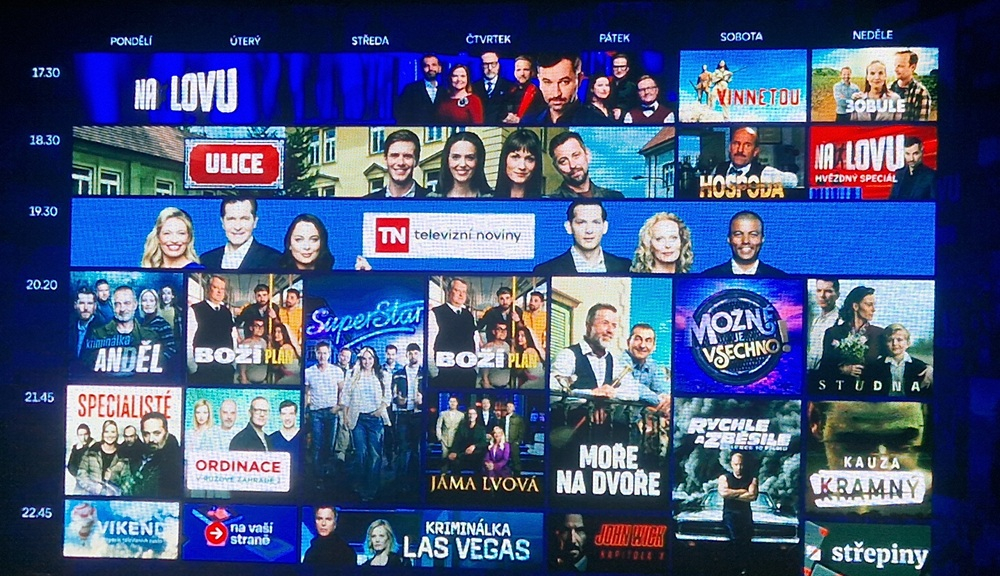
Mondays on TV Nova and TV Prima will be marked by reruns of the detective series Specialisté (Nova) and Polda (Prima), Wednesdays and Fridays will be marked by Vyprávěj (ČT1) and Sundays by Kriminálka Anděl (Nova). Tuesdays and Thursdays will again remind of Chalupáři (Nova) before Bratři a sestry appears for its last season, and Prima is also waiting for the return of Polabí, which is fitting Czech films into the series’ usual time slot.

Next up is the foreign series Inspektorka Candice Renoirová (ČT1), again on Tuesdays and Thursdays. From the foreign productions, the Slovak crime series Neuer will also be presented, which will occupy the Sunday evening airtime. In January, ČT will also include a rerun of the series Pustina as well as the series Četnické humoresky.

Nova continues with the reality show genre on Wednesdays in the form of Výměna manželek and the dating show Bachelor Česko.

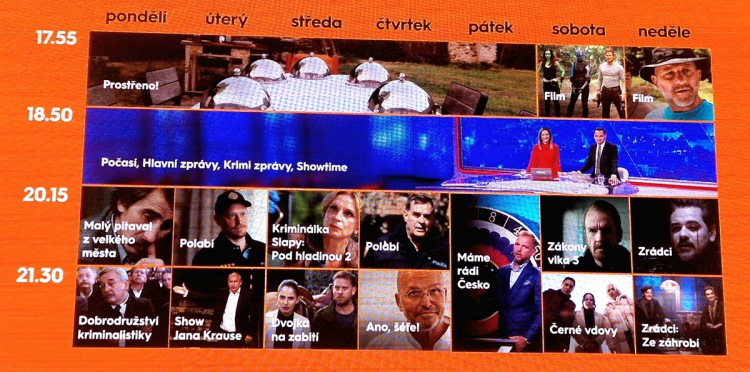
A change from last year will be made to the order of the shows in prime-time, when after the end of the daily series ZOO, Prostřeno (Prima) returns to the time from 18:00, preceded by reruns of Ano, šéfe!.

Announced news from commercial television stations Nova and Prima can be expected in the coming months of the new year.

Source: mediaguru.cz
ONEPLAY IS ALREADY AT THE LEVEL OF VOYO. THEY WON’T GET ANY MORE EXPENSIVE IN THE NEW YEAR

Familiarity with the Oneplay brand, which was established in the spring, is already at the level of the former Voya. According to Nova CEO Daniel Grunt, awareness of the service has grown very quickly. But 2026 will be marked by further work with the brand, he says.

The Oneplay platform, which was created in March 2025 by the merger of the Voyo video portal and O2 TV, is three quarters of a year old. According to TV Nova CEO Daniel Grunt, it has managed to connect two initially disparate worlds surprisingly quickly, given that it was a project that involved two companies with different cultures, business models and technology.

“It was an extremely complex and large project. We worked on it together for two and a half years. We each started from different market conditions, where O2 operates in the satellite market and we operate in the streaming market, where the customer can leave at any time,” Daniel Grunt, CEO of TV Nova, described to MediaGuru.cz after the press conference of TV Nova and Oneplay on the spring programming scheme. It is Oneplay that is set to become the “centrepiece” of Nova’s activities in its future direction.

The average user watches five hours a day

Overall, viewers have watched more than 2.2 billion videos on Oneplay since the service launched on 10 March 2025. On average, they watch 35.5 hours a week, meaning the average Oneplay user watches more than five hours a day. The wide range of content, from reality shows, series, movies to a variety of sports, brings hundreds of thousands of users to the platform at any one time.

Nova’s CEO admits that initially Nova underestimated the overlap of users between the two services, believing that there were fewer Voya and O2 TV users than there actually were. This essentially meant a reduction of tens of thousands of customers because they naturally chose only one service. However, the situation quickly stabilised and the number of subscribers has been growing steadily since the spring. Daniel Grunt does not give specific figures, but he says that the monthly trend follows seasonality. “The growth is in leaps and bounds according to the season. In the summer it was good that we didn’t decline because Farma worked perfectly as a retention tool. And in the fall season, both the series and Love Island, for example, work. Plus, the latter had its best season this year,” he says, adding that the finale garnered up to half a million votes. “I’m pleased that Oneplay is attracting young people who are very hard to catch on TV these days,” he says.

Growing familiarity and continuing to work with the brand

In terms of familiarity, Grunt says the Oneplay brand has essentially grown to the level of Voya in nine months. “We’ve built a brand that is already extremely strong. When I look at the top of mind metrics, we’re plus or minus at the level where Voyo was, so we’re a close second to Netflix,” he assesses. Awareness of the service (awarness) has grown very quickly, he says. “But we have about two years of explaining what Oneplay actually is and what the benefits are,” he adds. In the coming year, therefore, Oneplay will focus on brand work and “basic hygiene”, for example in the form of corrections to technical functioning. For now, however, it has no plans to change the pricing or set-up of its packages. “Next year, prices will definitely stay. We are not thinking about change yet, it’s early days,” concluded Daniel Grunt.

Source: mediaguru.cz

THE GREY AREA OF STREAMING: OPERATORS CRACK DOWN ON ACCOUNT SHARING, VIEWERS LOOK FOR ALTERNATIVES

Monthly subscriptions for access to television and VOD services continue to rise in price. What’s more, each one has something to offer, but none has everything. As a result, users rely on discreet, friendly assistance and share access passwords to reduce costs. Or they search for content on ‘alternative’ streaming portals, where programmes are played in embedded windows with dangerous scripts.

Consumers are essentially creating their own virtual service packages. Operators warn that this is a violation of their terms and conditions. Global services are fine-tuning technical measures to cut off freeloaders. Czech operators do not yet see this as a major problem, but they, too, refer to contracts and limited numbers of simultaneous streams.

Users’ wishes have remained the same for a long time: to have as many films, series and sports as possible in one place and at an affordable price. However, what is acceptable to users is difficult for providers to accept, as they bear the costs of development, technology and licensing rights. Moreover, costs are rising with all the “any device, unlimited streams” approaches that users take for granted. In addition, every major player has its own exclusive library of programmes that it does not want to share with its competitors, as this would jeopardise its revenues.
Those who wish to watch a wide range of programmes will inevitably end up with multiple subscriptions. And with that comes the temptation to share access outside the household.
Terms and conditions usually stipulate that sharing passwords with third parties outside the household is not permitted, even if the operator tolerates temporary viewing while travelling. Platforms also argue that there are security risks. Sharing a password can compromise the entire account, as whoever has the password can change settings, payment information and so on.

Netflix has started charging for sharing outside the household and allows one additional person to be added for CZK 99 per month. Disney+ has introduced a similar “Extra Member” add-on for CZK 139. HBO Max is testing the “Extra Member” concept in the US. They are thus trying to convert informal user practices into regular revenue, but even this measure has its limits. In most cases, it is not possible to add more than one or two additional users, and they cannot create multiple user profiles.
Czech operators all agree that sharing outside the household is not permitted, but their approach to enforcing the rules varies significantly. The largest domestic player, TV Nova, points out that a higher number of simultaneous streams is reserved for family viewing on the Oneplay service. “Even the name suggests that sharing is intended for family members,” said Barbora Dlabáčková, Head of Communication.

T-Mobile emphasises the binding nature of its terms and conditions.

“The customer is obliged to ensure that access to the service is not shared with persons outside the household or family members,”

explains Johana Valtrová from the press department. Telly has a similar interpretation. The operator’s CMO, Jan Schöppel, states that sharing access outside the family is a clear violation of the terms and conditions.

Vodafone describes the situation differently, admitting that informal sharing occurs quite often in practice. “We notify our customers in such cases, but we do not technically block them at this time,” says Ioannis Papadopoulos. Vodafone also points out that with the possibility of up to six simultaneous streams, the temptation is naturally greater.

SledováníTV states that it does not consider password sharing to be a major problem, as the service limits the number of paired devices and parallel playbacks. Pecka TV takes a similar stance, arguing that technical measures are enforced by the broadcasters. “The limit on simultaneous streams is designed to protect the rights of content owners while allowing mobility for household members,” said Matěj Čičák, Head of Marketing. GoNET, the operator of Lepší.TV, adds another detail: some television stations require their own limits, which is why the service strictly enforces them for selected programmes.

The responses we received indicate that sharing is undesirable, but strict controls are not yet common. Most services rely on the fact that limits will logically restrict the number of people who can use the account, and that user behaviour will thus remain “within limits”.
However, completely outside this area is the grey zone of websites that present themselves as “shared link catalogues”. Sites such as Kukaj.to, Sledujfilmy and Bombuj create an environment strikingly similar to regular streaming services, including a tile-based graphical interface and players. However, they do not have or host any content of their own. In fact, this model is based on embedded video, redirection to external storage, and a dense layer of advertising.

Accessing a programme often requires closing multiple advertising windows. These sites defend themselves by arguing that they do not store content, but only link to it.

“Embedding or framing means distributing works via links or frames. There is a widespread misconception in society that it is permitted and legal, but this is not the case. In other words, it is not possible to absolve oneself of responsibility for copyright infringement simply because a specific file ‘carrying’ the work is not used, but ‘only’ a link to it,” points out the Association of Commercial Television.

“The user does not infringe on any rights by simply linking to another website where the copyrighted work is located. On the other hand, embedding should be assessed on a case-by-case basis. Czech courts have ruled in the past that embedding is considered a form of making a work available to the public and, therefore, a form of use of a copyrighted work,”

adds the Association.

In 2016, the Court of Justice of the European Union ruled that the financial aspect of linking to content is also an important consideration. The mere placement of a link to a protected work that has been published elsewhere without the author’s consent is not considered “communication to the public” if the person who publishes the link does not profit from it and does not know that the work has been published unlawfully. However, if the link is published for profit, it is assumed that the person knows about the illegality.
At the time, the dispute concerned links to illegally published photos from Playboy, which someone had obtained before they were published in the magazine and uploaded to the Australian server FileFactory. The article with the links was published by one of the most visited websites in the Netherlands. When Playboy’s publisher succeeded in having the photos removed from one storage site, the server operator updated the article and referred readers to another illegal source.

In this context, it should be noted that websites with embedded players are surrounded by advertising systems and scripts from which the website operator receives commissions. Clearly, this is not charity. The money ends up in the pockets of the operators of these websites, not with the original copyright holders.

DIGITAL PIRACY IS BECOMING AN ORGANISED BUSINESS, WARNS EXPERT

The grey area in various forms has accompanied the distribution of digital content from the very beginning. One of the leading technology managers spoke to Broadband TV News about this long-standing problem, which is now “exploding”.

The interview, which was published a few days ago onBroadband TV News, warns of a dramatic increase in piracy, which has turned into a form of organised business, to which operators must respond by changing their strategy. Maria MalinkowitschofVerimatrix, one of the world’s leading cyber security companies, points out that traditional control methods are failing, as “81% of requests to remove illegally uploaded content are now ignored”.

According to the manager, companies are still mistakenly focusing on addressing the consequences rather than the causes. She therefore emphasises the need for a fundamental shift, whereby “the industry must move from mere reaction to detention and prevention”, which she considers to be the only viable long-term solution. Malinkowitsch identifies the abuse of distribution networks and unprotected applications that enable mass real-time streaming theft as a key threat.

How digital pirates steal

Traditional forms, such as torrents, are giving way to more sophisticated forms of piracy. The main form today is what we might call“piracy as a service”– complex illegal streaming platforms that function like professional platforms such asNetflix, with their own interface, recommendation system and thousands of channels, including premium sports. The second key form is“CDN network theft”– hackers steal login details from legal applications and use them to download original content directly from the servers where it is legally stored.

A long-standing problem is the distribution of television content via web browsers, smart TVs, smartphones or tablets, which are more easily accessible than the classic set-top boxes with encryption via decoder cards used in the past. Older viewers may remember the arrival of the Romanian satellite serviceDigi TVand its super-cheap offers. Piracy even reached such a level that keys could be obtained automatically using specially modified software.

A “business” like any other

On the dark web, which is referred to as the dark layer of the internet, you can buy a ready-made package for operating such a service. It is a completely illegal platform that already includes a recommendation system, a user management system, an administration interface, payments via payment cards and cryptocurrencies, and thousands of channels, including premium sports. The whole issue was described very well by theSynamedia portal less than three years ago.

How to deal with such services?Artificial intelligence helps significantly. Monitoring is performed using AI-controlled systems that scan the web, illegal IPTV platforms, and social networks (especiallyTelegramchannels, where “operators” find resellers). Watermarking plays a key role in detection – invisible marks are inserted into videos, which remain intact even after recoding or other manipulations. When the content appears on a pirate platform, this watermark can be identified and its exact source traced to find out who is responsible for the theft.

An example of a successful fight from the Czech Republic

TheStream Cinema Communityadd-on was long one of the most serious piracy tools on the Czech market, through whichKodiusers accessed content from all key players such as Netflix,Disney, HBO MaxandPrime Video. The technical complexity of combating this add-on lay in its legal architecture: the service itself did not host any content, but only functioned as a search engine and player for links to files stored in cloud storage.

Although the add-on (and its alternative, Stream Cinema) had been known about for a long time and was considered problematic, it wasthe Association of Commercial Television (AKTV), which represents the Nova, Prima and Óčko groups on the domestic market, that finally managed to do something about it after years. It completely disappeared from this online platform, the SCC “service” ended completely, and its alternative lost the content protected by AKTV.

Interview available here.

Source: mediaguru.cz

GERMAN POLICE RAID SUSPECTED PAY-TV PIRACY RING

Authorities in Germany have carried out coordinated raids across three federal states as part of an investigation into a suspected organised pay-TV piracy network.

The action targeted four men aged between 41 and 51 accused of large-scale card-sharing and the illegal provision of IPTV services.

According to the public prosecutor’s office in Dessau-Roßlau and the State Criminal Police Office (LKA) of Saxony-Anhalt, searches were conducted on 2 December 2025 in Magdeburg and Lutherstadt Wittenberg, as well as in Delitzsch (Saxony) and Heldenstein (Bavaria). The investigation centres on allegations of commercial and gang-related computer fraud within the cybercrime domain.

Investigators believe the suspects unlawfully shared pay-TV smartcards from a major provider over several years, distributing access to a large number of users via the internet. The resulting financial damage to rights holders is estimated to be at least in the mid-six-figure Euro range.

During the raids, police seized extensive evidence, including computer systems, satellite receivers, IPTV boxes, servers, data storage devices and smartphones. Officers also performed live forensic captures of volatile data on external servers and were able to shut down illegal card sharing servers immediately.

The investigation is ongoing, the authorities said.

Source: broadbandtvnews.com

CZECH INTERNATIONAL AI FILM FESTIVAL WELCOMES AGAIN A SHOWCASE OF THE BEST FILMS MADE WITH AI

The Czech International AI Film Festival 2025 will showcase top films selected from more than a thousand submissions, offer meetings with experts and filmmakers in a panel discussion, and culminate in an award ceremony. An exceptional opportunity to see the future of film on the big screen awaits you. This year CIAIFF is entering its biggest and strongest year yet, with a record number of entries from around the world and ambitions to become one of the leading AI film festivals in Europe.

The Czech Association of Artificial Intelligence (CAAI), in collaboration with YDEAL and the zero1cine platform, invites all of you who are interested in where filmmaking is heading to the third edition of CIAIFF, an event with an international reach that brings together film, art and technology and proves that AI is not just a technical tool, but also a creative partner capable of turning dreams, ideas and a distinctive vision into a cinematic reality.

Czech Association of Artificial Intelligence (CAUI), the leader of the Czech AI ecosystem, together with partner agency YDEAL and platform zero1cine presents the third edition of the Czech International AI Film Festival (CIAIFF), a unique event that connects filmmaking, technological innovation and new forms of visual storytelling. The festival will take place on 13 December 2025 at Prague’s Cinema City Slovanský dům.

“CIAIFF is not just a film festival, but a laboratory of the future. It shows that AI in film is not a substitute for human creativity, but a multiplier of it. Prague is thus becoming one of the world’s centres of film innovation,”

says Lukáš Benzl, Director of the Czech Association of Artificial Intelligence.

CIAIFF is one of the pioneering festivals of its kind in Europe and has long shown that AI is not just a technology, but also a creative partner that can capture the imagination, dreams and thoughts of creators in a way that the classic camera cannot. After successful editions in 2023 and 2024, which captivated media from Wired to Forbes, the festival comes this year in its biggest form yet.

International competition and record number of entries

More than 1,300 films from all over the world entered the competition section, from which the curators selected the ultimate selection of the best works of contemporary AI cinema. The festival will award prizes in nine main categories:

  • Best AI Film
  • Best Science Fiction
  • Best Documentary
  • Best Experimental Film
  • Best Music Video
  • Best Screenplay
  • Best Photography
  • Best Sound Design
  • Creative use of AI

The programme also includes special prizes from partners Curious Refuge, Eleven Labs and Minimax to support the winners with education, equipment and further development of their work.

International jury and inspiring guests

Winners will be decided by an expert jury of leading creators, producers and AI innovators:

  • Odair Faléco, festival president and award-winning director
  • Gaby Sitt, film director
  • Mauricio Tonon, technical AI artist
  • Michaela Ternasky-Holland, internationally acclaimed filmmaker

The accompanying programme will feature appearances by prominent figures who are pushing the boundaries of film and digital filmmaking, including:

  • Boris Eldagsen, visual artist and AI photography pioneer
  • Justin Hackney, co-founder of Wonder Studios
  • Elliot Grove, founder of Raindance Film Festival

Project blocks, networking and ceremony

The festival will offer a half-day programme including screenings of films in competition, discussion panels, meetings with filmmakers and AI experts. The highlight of the evening will be the award ceremony for the winners of each category.

“While cameras only capture what is in front of the lens, AI captures and translates what is happening in the mind of the artist, in their imagination and dreams, and this is unique to this medium,”

says Odair Faléco, president of the festival.

Since its inception, CIAIFF has profiled itself as a global platform connecting professional filmmakers, AI creators, technology innovators and the general public. This year’s edition aims to show that the future of film is not just beginning, it is already underway.

CIAIFF is a platform open to filmmakers and lovers of film, art and technology – it doesn’t matter if you are an established filmmaker, a visual artist, an AI enthusiast or just someone who wants to see where film is heading in the new decade. The festival will appeal to anyone who believes that AI can bring new aesthetics, new forms of storytelling and push the boundaries of creativity. It’s also a unique opportunity for young talented filmmakers – the competition is international and open to anyone who uses AI as a major creative tool.

Practical information:

Date: 13 December 2025 from 15:00
Cinema City – Slovanský dům, Na Příkopě 22, Prague
Tickets: available now on GoOut (previous editions were sold out)

Source: asociace.ai

Privacy Overview

This website uses cookies so that we can provide you with the best user experience possible. Cookie information is stored in your browser and performs functions such as recognising you when you return to our website and helping our team to understand which sections of the website you find most interesting and useful.