
🎄 Merry Christmas and all the best in the New Year wishes AKTV together with ScreenVoice.cz

In the autumn, the Chamber of Commerce conducted a survey among members of the Cultural and Creative Industry Section on the topic of copyright infringement on the internet. A total of 23 respondents from among film producers and distributors, TV broadcasters, book publishers, as well as professional associations of copyright holders took part in the survey. The clear conclusion of the survey is that all respondents have experience with illegal sharing of their works online and are trying to combat it, but the current options for copyright protection on the internet are ineffective and too costly and time-consuming.
The aim of the survey was to find out how widespread illegal sharing of copyrighted works is in the online environment, whether copyright holders are spending resources to protect them and which services they consider the most harmful in this respect. The survey involved rights holders of films, TV series, books or music, most often companies in the SME segment, which exercise copyrights to units, tens, thousands and even millions of works.
Almost 90% of respondents said they monitor and report illegal sharing of their works online for deletion, most often by an authorised employee (83%) or an external company (39%). The most frequently monitored platforms are file sharing platforms (repositories), followed by YouTube and Facebook. The most frequently involved repositories are uloz.to, prehraj.to, fastshare.cz, datoid.cz, edisk.cz, sdilej.cz, webshare.cz and sledujte.to.
“In the survey, copyright holders independently agreed on a list of websites where massive infringements of their copyrights occur most frequently. While the operators of these services try to play the role of cloud storage providers who are not responsible for the content they store, it is gradually becoming clear that this alibi will not be enough for them for much longer. That is why the operators of perhaps the most famous service of this type, ulož.to, have decided to discontinue the option of public file sharing. We firmly believe that other repositories will soon follow suit and that internet piracy in this form will hopefully be eradicated soon,”
says Marie Fianová, Chairwoman of the Cultural and Creative Industry Section of the Czech Chamber of Commerce.
A second aspect of online piracy is the financial cost of protecting works. Nearly 40% of respondents said they spend more than CZK 50,000 a month on monitoring and reporting works, and 22% even more than CZK 100,000. A third of the respondents also chose to take the costly legal route, with more than half a million crowns spent in the past three years by a quarter of respondents.
“Copyright holders are spending hundreds of thousands to millions of crowns a month to protect their works on repositories, while the operators of these services still refuse to take their share of responsibility and implement measures to prevent their services from being used for pirate sharing of copyrighted works. This certainly does not seem right to us,”
adds Marie Fianová.
However, respondents consider protecting their rights at court to be costly and lengthy, and therefore ineffective in the long run. The creation of an out-of-court mechanism that could, as a last resort, make massively infringing websites inaccessible is suggested as a suitable solution.
Agcom’s plans to combat online piracy in Italy are taking shape.
The communications regulator has now commissioned its so called ‘Piracy Shield’, designed to take down sites that illegally broadcast live sporting events.
“The platform is therefore functional. It is now up to the operators providing access (ISPs) who must obscure these sites, on the advice of the rights holders, to carry out the necessary activities to make the platform operational. Those activities must be completed by 31 January 2024,” said an Agcom statement.
The Piracy Shield is basically a machine to machine system. Accredited rightsholders can “upload” the reports of violation, with evidence of how the breach has taken place. The platform then automatically directs them to the accredited ISPs who provide for the blocking of the IP address within 30 minutes.
The platform requirements defined by the Authority were discussed and shared as part of the work of the Anti-piracy Technical Committee convened by Agcom, in collaboration with the National Cybersecurity Agency, which took office last September 7.
The work of the committee, which was also attended by representatives of the Mimit, the Postal Police and the main Associations for the fight against piracy and the protection of copyright, was attended by the Special Units of Goods and Services of the Guardia di Finanza at Agcom which, within the framework of the current memorandum of understanding, will collaborate with the Authority to ensure the start-up and efficient operation of the platform through, among other things, constant assistance to users of the Piracy Shield.
Source: broadbandtvnews.com

Czech Television’s stations returned to the position of the TV group with the highest share of viewership in the audience group over 15 years of age by a narrow margin. This is according to the official ATO-Nielsen measurement data for November 2023. The aggregate share of CT stations reached 28.48% throughout the day. However, compared to the same month last year, CT’s share was 1.48 percentage points lower.
The position of the three strongest TV groups is balanced in full-day viewership of 15+. CT is followed by Prima (28.06%) and Nova (27.86%).
Year-on-year, the best performing group was Nova, which gained 0.75 percentage points and even one percentage point in the 15-54 group. At the same time, Nova remains strongest in the 15-54 and 15-69 audience groups, as well as in prime time in all critical categories.
Atmedia continued its growth in November, exceeding 6% share (6.26%) in the 15-69 group. Television Seznam also increased its share.
More on mediaguru.cz
Source: mediaguru.cz

The High Court in Olomouc has upheld the preliminary ruling issued by the Regional Court in Brno on a petition by the Association of Commercial Television (AKTV), requiring the operators of the eDisk.cz and Sledujteto.cz repositories not to allow the uploading and downloading of copyright-protected works of Nova and Prima TV Groups. The court thus upheld AKTV’s argument that the repository operator had committed an unfair competition act referred to as “stowaway” or “free riding” (also known as “impermissible parasitism”). Similar decisions have been issued against other repositories in recent months.
As part of its activities, AKTV focuses intensively on combating the illegal distribution of television series and other protected works, especially in the environment of internet repositories. AKTV’s core legal argumentation for combating internet piracy has been repeatedly found correct by the courts. The most significant achievements so far are the preliminary rulings issued against the operators of the Fastshare platform or the eDisk.cz and Sledujteto.cz repositories.
Television broadcasters have long spent large amounts of money on the production of original Czech series and other audiovisual works subsequently published on television or in the online video libraries Voyo and prima+. At the same time, however, these exclusive series, films or programmes are illegally disseminated almost immediately after their official publication via online repositories where they are available for download or online playback. These repositories, such as eDisk.cz or Sledujteto.cz, not only provide their users with the space to upload and download these works but encourage such infringement by rewarding active users who upload popular titles that are then downloaded or watched online by other users.
“The decisions of the Regional Court in Ostrava and the Regional Court in Brno, both of which were upheld by the High Court in Olomouc, represent a significant breakthrough in our previous decision-making practice and a very important signal for all copyright holders. Every year we spend hundreds of millions of crowns on the production of original Czech works for our audiences, and virtually all works are illegally shared immediately after publication. This fundamentally damages our business model and reduces our return on investment. Absurdly, repository operators profit significantly from our attractive content, for example by selling download credits or even advertising alongside our copyrighted content,”
says Klára Brachtlová, President of the Association of Commercial Television.
AKTV initiated legal action against the operators of eDisk.cz and Sledujteto.cz this year. In the spring, AKTV filed a motion for a preliminary ruling with the Regional Court in Ostrava against the operator of Fastshare and in the autumn a similar motion against the operators of eDisk.cz and Sledujteto.cz with the Regional Court in Brno. Both courts issued preliminary rulings on the grounds that the platforms’ profits are generated through the continuous unauthorised distribution of titles whose creation is financed exclusively by Nova and Prima. The operators of the repositories in question were ordered to refrain from allowing the uploading, downloading or online viewing of exclusive audiovisual works of Nova and Prima TV Groups. The preliminary ruling was then confirmed by the High Court in Olomouc as the Court of Appeal.
“We are very pleased that the court has upheld our legal view that other competitors cannot be allowed to actively enable, support and develop a business based on deriving a financial benefit from the actions of their users that is based on massive infringement of others’ copyright. The court has found that this may cause harm to both television groups, in particular in the form of audience churn, dilution and loss of exclusivity of individual series, reduced interest in their video libraries, as well as reduced advertising revenue and reduced profits from subscriptions to on-demand services,”
adds the counsel of the Association of Commercial Television, doc. JUDr. Dana Ondrejová, Ph.D., Legato legal office.
“Our long-term goal is to protect our content and prevent any loss of its value as much as possible. We are ready to negotiate with the operators of Internet repositories and jointly set conditions and technical measures to prevent illegal sharing. If, however, instead of engaging in dialogue with us, these operators prefer to transfer their service to another domain or change to a foreign company based in the Seychelles, we consider this a clear signal that they are trying to avoid their legal obligations in every possible way and are indifferent to compliance with the law,”
adds Klára Brachtlová.
In addition to taking legal action against the operators of the most infringing repositories, the Association of Commercial Television has long focused on awareness-raising activities. As part of these initiatives, it operates an information website on copyright, which is available at aktv.cz/copyright. You can find there a glossary explaining the terms used in the field of intellectual property protection, answers to frequently asked questions (FAQs), and regular news on internet piracy. There is also an up-to-date series of articles on the new study Online Copyright Infringement in the European Union, published by the European Union Intellectual Property Office (EUIPO), available on the website.
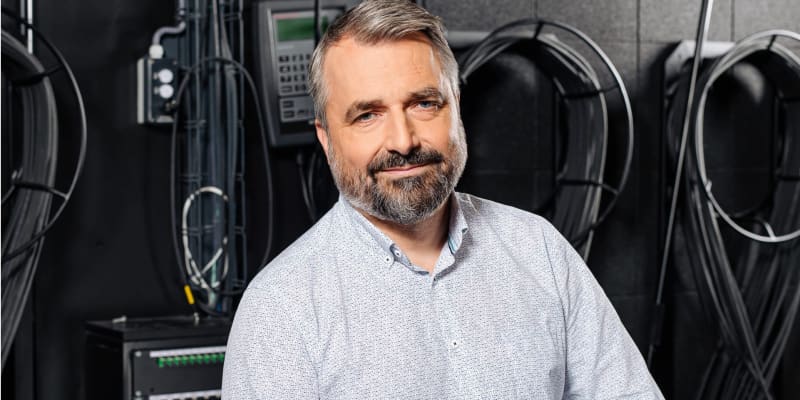
Despite the global crises and mixed expectations, the advertising market grew moderately in 2023 in all media types, says Vladimír Pořízek, FTV Prima group’s CCO. He also talks about how the warm autumn weather has affected the number of viewers in front of their screens or why tv stations have to increase the price of advertising.
How successful is 2023 for Prima in terms of business?
Initial expectations of what 2023 would look like were very unsure. Nobody knew whether there would be another crisis, how clients would behave, how people would behave and how consumption would grow. I remember that we prepared a business plan under about four scenarios – from a 20% market decline to a flat market (a period when the media market in terms of investment volume shows no signs of growth or decline, ed.). At the moment, we can say that the market is growing slightly in all media types. We are growing with it. So, I think it is a successful year.
What do you expect in the next year?
We believe that having succeeded this year, the growth will continue. I do not see any signs anywhere to the contrary. However, let’s keep our fingers crossed, it is a strange time.
It is often said that due to the warm weather this autumn, not too many viewers were sitting in front of their screens. Does the weather really have such a big impact on viewership?
The influence is enormous. Every year, the TV rating curves clearly show that the least number of viewers sit in front of the TV in the summer and the most during the winter. However, this autumn, temperatures remained well above the long-term average throughout September and half of October. It has been extremely warm, which is hugely evident in the viewing figures, which are down between 15% and 20% on last year. Combined with the significant increase in demand for advertising time, we had an insoluble problem. But all television stations are facing it.
In 2024, you are going to sell advertising time at a higher price than in previous years. Why?
Because inventory (advertising space in a given medium that can be sold to clients, ed.) is dwindling, viewers are fewer and fewer, and the cost of producing our content is rising. If we want to maintain the same margin, there has to be a price increase.
Another change you are introducing concerns strategic trading. You are now targeting adults aged 18-69, up from 15-69. Why did you decide to do this?
The main reasons for the change include social responsibility and legal constraints. Many clients cannot and do not want to target audiences under the age of 18. These are mainly producers of confectionery or alcoholic beverages. Another reason is the quality and credibility of the audience we reach, where we provide our clients with a more mature and solvent audience. And last but not least, we have more of these GRPs (Gross Rating Point or cumulative viewership – indicating the percentage of viewers from a given target group who have watched the show, ed.).
Campaign planning using artificial intelligence is also a new feature. How will it work?
Clients tell us which target group they want to focus their advertising on, and the computer software optimises the campaign planning to ensure everyone is as satisfied as possible. Our experience to date suggests that our clients’ campaign affinities could improve by up to five percent.
Another new feature is that you want to know from clients in advance how they plan to spread their investments over the year. Why?
So that we can better plan our inventory and handle client advertising campaigns more efficiently.
Do you plan to connect the online and TV worlds more?
We certainly have a lot of other projects in the pipeline. The online video-on-demand segment will continue to grow at the expense of linear TV. That’s why it’s also necessary to bridge these worlds in terms of planning and handling campaigns for clients. This is what cross-platform measurement, of which we are pioneers in the Czech Republic, is designed to do and we are therefore able to measure the reach.
What would you wish Prima for 30 years on the television market?
I wish it to do well, to flourish, to have better and better programmes and to entertain more viewers.
Source: cnn.iprima.cz

One of the largest piracy services in the Middle East-North Africa (MENA) region has been shut down in Egypt by the Egyptian police, in collaboration with the Alliance for Creativity and Entertainment (ACE).
According to ACE, CimaClub enabled users to directly download or stream pirated content, offering a VOD library of nearly 50,000 movie and TV series titles in Arabic and their original versions. All ACE members were affected.
It adds that the service attracted more than 29 million monthly visits through its 65 domains. Most of the traffic originated from Egypt, France, Canada, the United States and Germany.
Egyptian police identified and confronted the operator in Giza, Egypt.
Commenting on the shut down, Natasha Matos-Hemingway, chief commercial and marketing officer at Shahid, a leading Arabic streaming platform by MBC Group and ACE member, said: “ACE remains persistent in cracking down on piracy, collaborating closely with authorities to pinpoint unlawful operators in the MENA region.
“This wouldn’t be possible without the assistance of the Egyptian authorities involved, who work diligently to prevent illegal content sharing, and we are grateful to both. It’s no secret that piracy results in tremendous losses, not only for broadcasters, but for production companies and emerging content creators as well. At MBC Group, we remain aligned with ACE in its ongoing mission to protect the intellectual property rights of our creators. We are grateful to the Alliance for their great work throughout the year, and we look forward to continuing to fight content piracy together”.
Fiona Robertson, general counsel of OSN, a member of ACE, added: “Content piracy has severe implications across the entertainment value chain.
“As one of the leading entertainment companies in the region, we are committed to protecting the rights of all content creators by working closely with law enforcement and regulatory authorities in our operational markets.”
Jan van Voorn, executive VP and chief of global content protection for the Motion Picture Association and head of ACE, said: “We applaud the Egyptian police for their swift action in identifying the operator of one of the most notorious piracy services in the MENA region.
“The sheer breadth of this illegal operation affected every ACE member, compromising the intellectual property of numerous creators and content owners. Today’s action underscores the power of a global and joint effort to protect the integrity of the creative marketplace”.
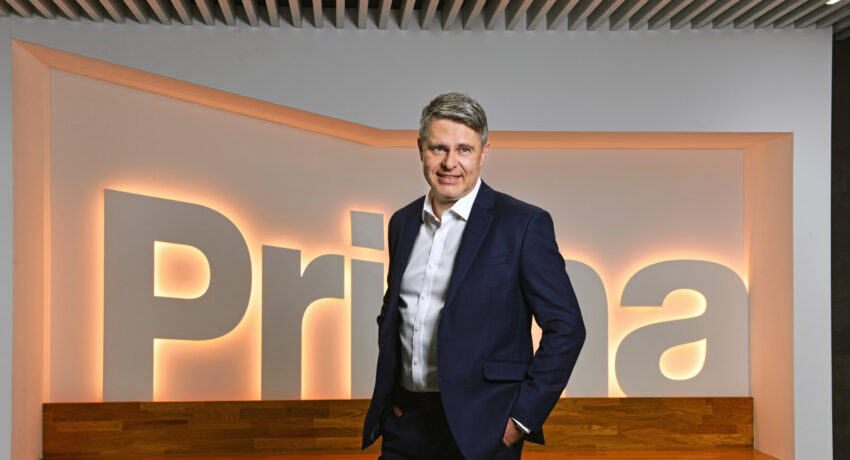
It is an incredible sum of between CZK 1.5 and 2 billion a year, says the CEO of Prima group, Marek Singer, about the new revenues for Česká televize (Czech Television) in the form of increased licence fees. And do shows like Stardance fulfil the public service role? We present an excerpt from an interview for the CNN Prima News magazine, which has been on newsstands since 13th November.
Is there still real freedom of speech in the media as we know it from the “golden 1990s”?
Compared to the 1990s, the whole society has become more regulated. If you look back today the 1990s were very specific, and not only in terms of news. It is unbelievable what was broadcast then. Remember [the politically incorrect satirical show] Česká soda. Nobody would air anything like that nowadays because they would get about 20,000 fines from the Council for Radio and Television Broadcasting. And on the top of that, they would get slagged off on social media for being politically incorrect. Back then, it was absolute freedom. I am not saying it was ideal but of course we all liked it in the 1990s. It was just a new world. Now it is, let’s say, more civilised.
Is it better or worse?
I will leave that up to everyone because everyone has their background and is sensitive to something… So yes, some “protection of topics” is probably OK. But everything in moderation, which also applies to any protection and regulation.
You mentioned Česká soda. Today, satire has completely disappeared from czech TVs. It seems to me that under the weight of online hates, everything has become very serious. Have you ever thought of putting on an incorrect programme like Česká soda on Prima?
Of course. But it has to be said that Česká soda has brought together some amazingly talented people at the right time. They were responsive and incredibly creative… The whole context, the whole environment encouraged the show because making fun of everything and everybody is what we Czechs enjoy. And the best thing about it at that time was that suddenly it could be done in public.
And can’t it be done again now?
I think it definitely can. I just think that everybody is locked into their own bubble, and it is obviously related to social media. Satire is so quick to tip over into attacks and counterattacks. And into punishments and penalties. Yes, few people can distinguish right from wrong, smile, rise above it. I just happened to be listening on Spotify to an Indian woman living in Sweden who has a politically incorrect podcast. She said that she often gets into conflicts with her middle child over “racism” because the child is very, very woke – simply unable to understand the nature of politically incorrect humour anymore even though the podcast author is a dark-skinned Indian woman… But she just cannot explain the joke at home.
But it is just an internet podcast. It is hard to say if swedish tv would air the same thing – probably not. There are two worlds: TV and the internet, one highly regulated, the other hardly regulated at all. Is that fair? Should both be more controlled, or should TV be less regulated?
I cannot imagine the internet being regulated any more but on the other hand, I think it should definitely be levelled because I do not see any reason why we should be regulated more than online media. I understood it in the past, TV reach was incomparably greater. We were more dominant. It made sense. But now it is just not true anymore. Yes, online channels have started down a certain path, there has been a kind of self-regulation, everybody does it its own way – Facebook’s regulation is different from what X (or former Twitter) does. I am not saying that self-regulation of these platforms is always good, but each of them is trying to deal with it somehow. And each is also responsible for how good, trustworthy and reliable their product is. So why shouldn’t it be that way in the TV business? Why shouldn’t we get to determine how open we want to be? TV is regulated everywhere in the world. If it was intelligent regulation, why not. But there are some downright archaic moments involving completely outdated standards. For example, we are not allowed to show violence on TV until 10 pm, not a single bad word – yet people on the internet, including children, talk like that at all hours, every day, morning and night.
What else do you think you are allowed to say in public? Is there a limit to freedom of speech, or can we say anything at all, no matter how controversial?
I don’t know. When I was 20, I experienced the revolution, anything was possible then. And it affected me so much that I just think the more freedom there is, the better. And so any kind of regulation for me personally is actually like a return to the old days. On the other hand, I understand that the generations that are growing up now are set up very differently, have a different threshold of sensitivity and a limited ability to work with other opinions. Maybe they need some level of protection so that they just don’t crumble. But I really can’t judge. I have always been more of a believer that everyone should deal with the world around them on their own. But take it as the opinion of a man from the last century.
And how is the media handling this new era?
It depends. There is a general tendency for the media to broadcast opinions, whether editorial or external, instead of providing information. And I am going to go back again to what our main point was when we built CNN Prima NEWS. There are different opinions, it is a boxing match, and you as a medium are the referee. You can’t go into the ring and box for one side. You as a medium just have to supervise the match.
CNN Prima News has been on the market for over three years. How satisfied are you?
I have got the numbers right here with me. In 2020, our viewership was 0.4%. In 2021 – 0.9%. In 2022 – 1.7%. In 2023 – 2%. I think CNN Prima NEWS definitely has the ambition to outperform ČT24 over time. We are doing an attractive newscast. In a good way. Attractive content. Fast, entertaining, explanatory but also engaging enough – plasmas, Magic Walls, use of 3D graphics and other modern technologies, and of course opinions from all sides. The trend of the fast times is fast and attractive news. So we should have a better chance of reaching and influencing more people than the public media. On the other hand, it certainly won’t just be through TV anymore, especially in terms of news, it just has to be a combination of TV, internet and social media. Multi-platform broadcasting.
You have publicly spoken out against increasing the licence fees for Česká televize. Let us recall that from 2025, the fees will increase by czk 25, from czk 135 to czk 160. What’s your biggest problem with this?
What bothers me the most is that even though CZK 25 seems like a relatively small amount, it really isn’t! It is a huge amount of money for Česká televize. If you multiply it by the number of people who will pay, because all the people who have a mobile phone will now pay, you get an incredible sum of between 1.5 and 2 billion crowns a year. I would build a new ČT1 with that money! That amount of money has a major impact on the market. And my question is: Do we need it? Do the Czechs need to put so much money into public media? Petr Dvořák, the former director of ČT, said that ČT needed a maximum of half a billion a year and suddenly it is 1.5 billion. Three times as much? Really?
Some critics have reproached ČT for airing expensive programmes like Stardance, which are more commercial in nature. Does that bother you? Does stardance, for example, fulfil the public service requirements?
The question is what public service requirements and public service roles are. The world has evolved and the definition of public service as it used to be is no longer sufficient. Public service should be redefined more precisely in its entire context, in the context of the new market, and not just in the context of Czech Radio and Czech Television. The new definition may include StarDance, I don’t know. As it is now, StarDance seems to be a commercial project. And that is the problem: Unless we clearly redefine public service as such, you can justify pretty much anything as falling within the concept.
The media market was scared of the crisis, at the beginning of 2023 it was quite retracted. What is the current situation in terms of advertising?
The demand is huge. At least in our company. But again, it has to be said that the situation is opaque. In Germany, for example, the advertising market is down 10% for the second year running. We may have got through the crisis but it is hard to say what will happen next. It looks like the end of the standard cycle: there was a big crisis followed by our recovery, then there was the boom and the next big crisis… It seems to me that it has all turned into a protracted, almost permanent hard time with no significant crashes, no clear waves and no indication when and where it is coming from.
The CEO of the Prima Group talks about the transformation of media due to social networks, the Green Deal, the future of business in Europe and the high ambitions of CNN Prima NEWS. Read the full interview in the CNN Prima NEWS magazine, now on newsstands.
Source: cnn.iprima.cz
A joint TV spot has been produced by commercial broadcasters associated in the Association of Commercial Television on the occasion of World Television Day, which falls on 21 November. AKTV members have been joining in the celebration of TV Day since 2017, but this year for the first time they are releasing their own TV spot to the world, highlighting the unique power of the TV screen. The spot will air on Tuesday, November 21 on all AKTV member stations and will also be placed online and on social media.
World Television Day has been celebrated annually by broadcasters around the world for 26 years. This year, however, the Czech commercial TV stations affiliated to AKTV have decided to take a different approach to the celebrations than in previous years and create their own programme. Together they have prepared a TV spot that will be broadcast on Tuesday 21 November on all the member companies’ stations. The spot, whose central idea is to highlight the diversity of television production and the unique power of the television screen to reach millions of viewers, is composed of the best of what the Nova, Prima and Óčko television groups currently offer.

“In previous years, we have taken inspiration from our foreign colleagues to celebrate World Television Day, but this year we decided to prepare our own Czech content. In addition to a beautiful spot, we have also prepared a unique programme for our business partners, a joint open day that will culminate in an entertaining TV show really focused only on our TV topics. I believe our guests will have a great time,”
says Klára Brachtlová, President of the Association of Commercial Television.
The main programme of the celebrations will be a spectacular entertainment show WE LOVE TV hosted by Libor Boucek, in which the teams of Nova and Prima will face each other. The CEO of the Nova group Daniel Grunt has invited famous actor Aleš Háma to help him, while the CEO of the Prima group Marek Singer will be supported by popular entertainer Jakub Prachař.
In addition to the evening show, visitors can also expect a varied all-day programme prepared by the Nova, Prima and Óčko TV groups for their partners. Visitors will be let into the TV kitchen, given a glimpse into news studios, series studios or live broadcasting.
Detailed information, photo galleries from the day and a recording of the show are available on the website – aktv.cz/weloveTV

Alliance for Creativity and Entertainment (ACE) has shut down tt-torrent.com, a torrent website that was operated out of Thailand.
According to ACE, the infringing site had been in operation since 2006, initially under the domain name Thailandtorrent.com and subsequently tt-square.com. TT-torrent.com was ranked the 156th most popular website in Thailand, according to Similarweb, and drew 26.3 million visits between January and September 2023.
Commenting on the shutdown, Sompan Charumilinda, executive VP of True Visions, said: “We would like to extend our gratitude to the Economic Crime Suppression Division and ACE for their invaluable help in the fight against content piracy.
“Piracy is a persistent problem around the globe, but the cooperation we have received from the Thai authorities and international organizations like ACE have led to some of the most successful enforcement actions in Asia. It is a fight that we will, and must, continue. Closing down sites like this reduces the damage done to Thai society, especially our youth, and benefits the creative economy, and the country as a whole”.
Jan van Voorn, executive VP and chief of global content protection at the Motion Picture Association and head of ACE, added; “The shutdown of tt.torrent.com marks another successful ACE enforcement action and another warning to illegal piracy operators everywhere that their days are numbered,” said. “This site put consumers at risk of egregious malware, undermined investment in the Thai content industry, and reduced tax contributions to the local government. The closure of tt-torrent.com is a win-win for all”.
Source: broadbandtvnews.com

One of the hypotheses put forward in a study on digital piracy recently published by the European Union Intellectual Property Office (EUIPO) looks at the relationship between attitudes towards piracy and the consumption of illegal TV, film, music, software and publishing content in EU countries and the UK. According to this hypothesis, there is a relationship between attitudes towards piracy and the amount of pirated content consumed.
The study on online copyright infringement in the European Union drew on, among other things, the Intellectual Property Perceptions Study published by the Office this summer to examine the state and evolution of digital piracy. The study is a follow-up to a previous study from 2017 and 2020. The main objective of the study was to gather insights into European consumers’ attitudes towards intellectual property (IP), the extent to which they respect IP rights and their perceptions of IP as a whole. The question “To what extent do you agree or disagree with the following statements? – Is it acceptable to obtain digital content illegally from the Internet or from apps if it is for my personal use?”
Attitudes towards pirated online content
Most Europeans generally find access to content from illegal online sources unacceptable. More than 7 in 10 Europeans do not think it is acceptable to use illegal sources if:
- the content they are looking for is not available within their streaming subscription (74%),
- they save money by doing so (73%),
- the price of protected content is too high (72%).
At first glance, these figures are positive. But seen the other way round, it means that, for example, one in three Europeans still find it acceptable to buy illegal goods if the original product is too expensive. For younger consumers aged 15-24, this is the case for half of the respondents (50%). Acceptance of illegal behaviour online is significantly higher among younger Europeans compared to older ones.
Moreover, around a third (34%) of Europeans agree that it is acceptable to obtain digital content illegally if it is for personal use.
The level of acceptance varies from country to country. For example, the proportion of people who consider illegal retrieval of content from the internet (for personal consumption) to be completely or rather acceptable ranges from 24% (Denmark) to 58% (Slovakia). Apart from Slovakia, this statement has (slight) majority support in Slovenia (56%), Hungary (54%), Bulgaria (51%) and Latvia (51%). The Czech Republic is among the countries where the level of acceptance of the use of pirated content for personal consumption is relatively high at 48%.
Those who have committed infringement have a more benevolent attitude
The study also found that people who have deliberately accessed online content through illegal sources in the last 12 months are much more likely to believe there are reasons to justify this behaviour than those who have not.
The proportion of people who admit that they have consumed pirated content online in the last 12 months also varies widely between countries, ranging from 9% in Finland and Germany to 22% in Malta. The Czech Republic is roughly in the middle of the ranking with 16%.
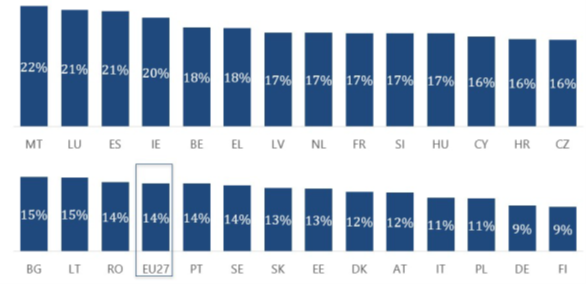
Intentional illicit access to online sources by country; Source: EUIPO
Profile of intentional users of pirated content
According to the study, the majority of people illegally using copyrighted content are men (17%), with women doing slightly better (12%). In terms of age, younger Europeans are significantly more prevalent (15-24 year olds 33%, 25-34 year olds 25%, 35-44 year olds 19%, 45-54 year olds 10%, 55-64 year olds 6% and people over 65 only 4%).
In terms of education, illegal content is consumed most by people with low education (18%). Illegal content is consumed more in large cities and most often by students (31%) and least often by housewives (9%).
Reasons not to use illegal online sources: price and availability of content
Concerns about exposure to harmful practices such as fraud or inappropriate content for minors may also be a reason for not using illegal sources. More than 8 out of 10 Europeans (82%) agree that illegally obtaining online content carries a risk of exposure to such practices. This view is shared by a clear majority – regardless of whether or not they accessed the content through illegal sources.
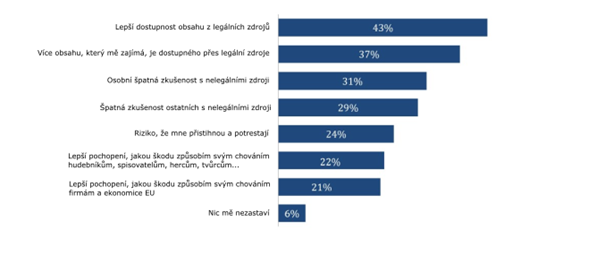
Reasons to stop using online pirated content; Source: EUIPO
Price plays a major role in motivating users to use illegal sources, as does the quality of content available from legal sources. The most frequently cited reasons that would make respondents stop using illegal sources would be better affordability of content from legal sources (43%) and greater availability of content of interest to them through legal sources (37%).
Intellectual property perceptions
A clear majority of Europeans say they have a good understanding of the concept of intellectual property and agree that it is important to respect intellectual property in order to protect the rights and revenues of producers of goods and content, as well as the quality of their products.
93% of Europeans also agree that it is important that inventors, publishers, creators and performers can protect their rights and be paid for their work.
Similarly, the majority (91%) consider it important to respect intellectual property so that others cannot falsely claim to be the creators or inventors of something that is not their work.
While awareness of the importance of IP protection is high, few Europeans think that consumers such as themselves are the main beneficiaries of IP protection (8%). Conversely, more than half think that performers such as musicians (54%) and creators of artistic content (52%) are the main beneficiaries of IP protection.
For the time being, most Europeans also consider the quality and variety of content offered through legal sources to be better than that available through illegal solutions.
However, 60% of those who have deliberately accessed online content through pirate sources in the last year report that it is easier to find and access the digital content they want through illegal channels than through legal services.
Source: euipo.europa.eu
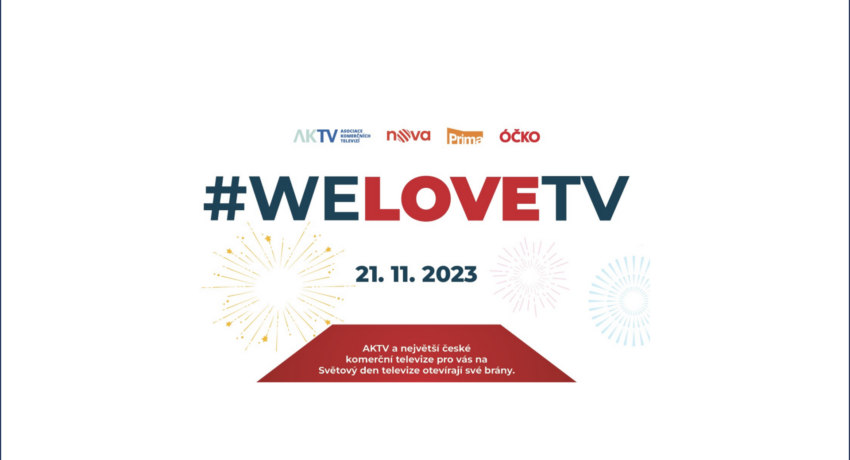
This year’s World Television Day on 21st of November, will be celebrated in style by Czech commercial TV stations. For the first time ever, they have prepared a joint programme for their business partners and collaborators, to whom Nova, Prima and Óčko will open their doors. The rich programme will culminate in an entertaining evening show WE LOVE TV, in which the teams of Nova and Prima, led by their CEOs, will compete.
World Television Day has been celebrated by broadcasters around the world every year for 26 years. This year, however, the Czech commercial television companies associated with AKTV have decided to celebrate differently than in previous years. Instead of a professional conference, they prepared a varied entertainment programme for their business partners and collaborators across the TV world.
The main programme of the celebrations will be a spectacular entertainment show WE LOVE TV hosted by Libor Boucek, in which the teams of Nova and Prima will face each other. The CEO of the Nova group Daniel Grunt has invited Aleš Háma to help him, while the CEO of the Prima group Marek Singer will be supported by Jakub Prachař. Who of them knows the TV world better? Visitors will find out on Tuesday, 21 November at 5 pm.
Nova prepared its program in its headquaters, newsrooms and ateliers.

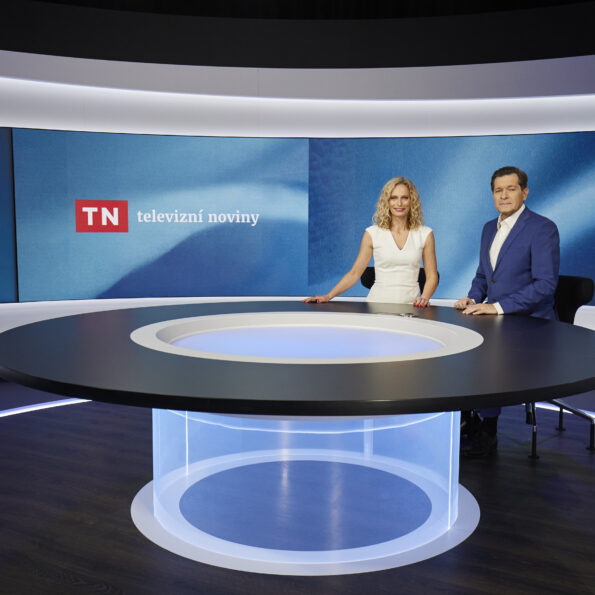


Television group Prima will take its visitors to the less traditional backdrop of the television world as technical background, radio and dubbing studios. There will also be a wheel of fortune for valuable prizes.
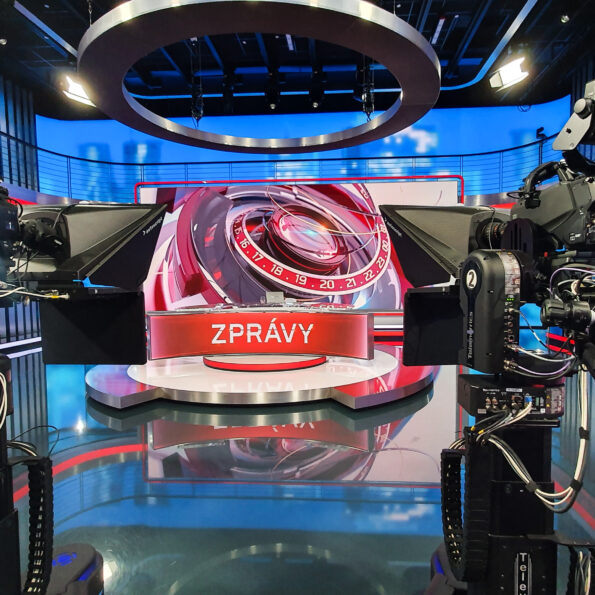


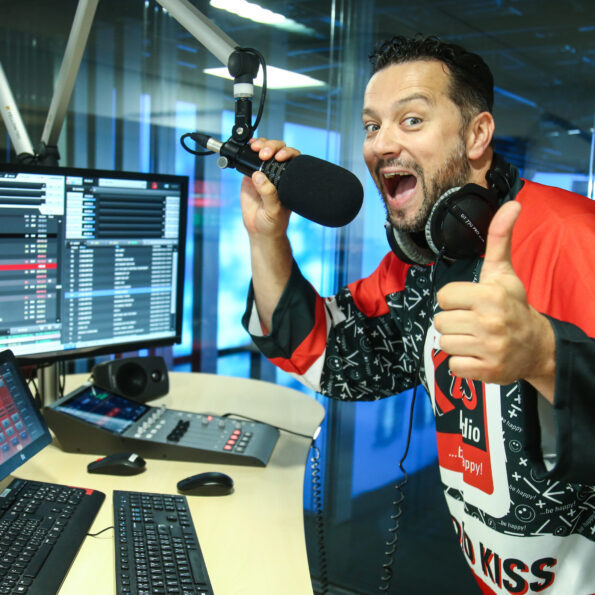
TV Óčko has prepared a glimpse into the TV kitchen for those interested in the live broadcast of Mixxxer, which you can be a direct part of.

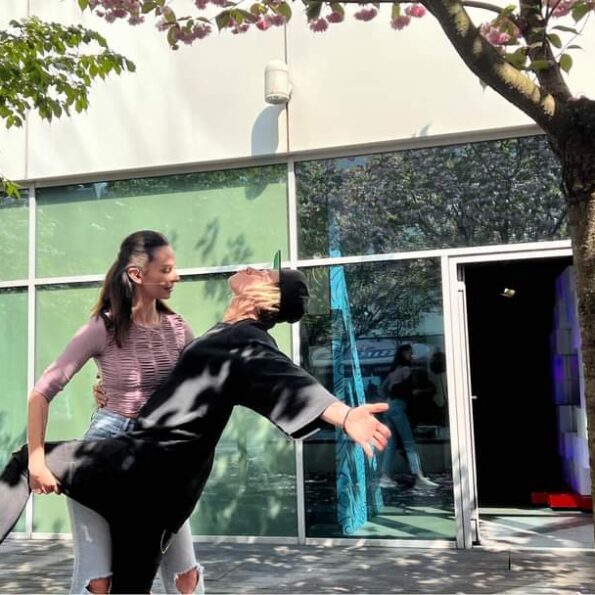

More information on aktv.cz/weloveTV