The Alliance for Creativity and Entertainment (ACE) has shut down Cuevana3, Latin America’s most notorious illegal streaming service.
This comes after the anti-piracy coalition identified the operator in the Piura District of Peru.
In a statement, ACE says that Cuevana3, formerly known as cuevana3.io, is the largest Spanish-language piracy streaming service in the LATAM region and ranked number one for website traffic over the past four years, according to data analytics company SimilarWeb. Cuevana gained notoriety as an online piracy brand, spawning numerous copycat operations. Its network of more than 20 domains attracted more than 800 million visits in two years and made a vast library of infringing film and TV content available in multiple formats.
Commenting on the shutdown, Jan van Voorn, executive VP and chief executive of global content protection for the Motion Picture Association and head of ACE, said: “The largest Spanish-language piracy streamer in Latin America is no more, thanks to a tireless, global effort involving law enforcement and judicial authorities in several LATAM countries and ACE’s global teams in LATAM and other parts of the world.
“In the past year and a half, we’ve also taken down several other high profile illegal services in LATAM, which sends a clear message to piracy operators in the region and worldwide that we are closing in”.
All Cuevana3 domains are being transferred to ACE and will be redirected to the “Watch Legally” page of the ACE website.
Digital Citizens Alliance report found that 72% of those who used a credit card to sign up for a pirated TV, movie or gaming streaming service reported fraud
Internet users that use a credit card to sign up for illegal piracy streaming services to gain access to movies, TV shows, and games face a serious risk of having their card used to run up charges they didn’t authorize, according to a new Digital Citizens Alliance investigation.
“Our latest report is further proof that piracy operators will go to any length to turn a profit off of consumers with an appetite for content, even those who are willing to pay for it,” said Tom Galvin, executive director of the Digital Citizens Alliance. “Combined with our previous research highlighting the risks associated with free piracy apps and services, the situation becomes even clearer. The pursuit of pirated content is an inherently risky behavior that threatens consumers’ devices, wallets, and privacy.”
The report titled, “Giving Piracy Operators Credit,” includes an investigation into how a Digital Citizens investigator’s credit card was targeted for $1,495 in illicit purchases and a separate survey that highlights a number of larger issues relating to pirated content.
The survey found widespread use of pirated content with one in three Americans admitting to watching pirated content.
The survey also found that 72% of Americans who said they used a credit card to purchase a piracy subscription service reported having an issue with credit card fraud over the last year.
To test whether credit card fraud was tied to piracy subscription services, Digital Citizens signed up for 20 piracy subscription services. Investigators signed for the services from February through April of 2023 using a new Capital One QuickSilver credit card that was used solely for this project.
The sites charged a set monthly subscription fee ranging from $5.99 to $40 and within two weeks, the fraudulent charges began, the group said.
The purchases were purportedly for grocery delivery, women’s apparel, computer software, a cash advance, and a large mystery charge of $850 that, fortunately, wasn’t processed. The charges appear to originate from China, Singapore, Hong Kong, and Lithuania.
Specific charges include:
February 22, 2023 – Eleven days after signing up for the first piracy streaming services – two charges of $17.21 each occurred listed as “GB Pay affectioni.” Affectioni appears to be a women’s apparel store in Qingdao City, China. GP Pay is a mobile payment service.
February 23, 2023 – Just a day later, a cash advance of $14.99 (along with an additional $3 fee) was made using the Wollito crypto platform. The credit card statement states that the purchase originated in Vilnius, Lithuania. No other information is available.
March 22, 2023 – A $16.60 purchase at a clothing store based in Hong Kong. The name on the charge was “clothingyoyo,” which corresponds to the Clothing Yoyo outlet based in Sheung Wan, Hong Kong.
March 31, 2023 – A $16.68 purchase for “thedailygroceries.” The charge originated in Jiaxing Shi in China. Although the name indicates its food-related, the website, thedailygroceries.com, which appears to correspond to the charge, sells jewelry such as necklaces and bracelets along with handbags.
April 30, 2023 – Two attempts for larger purchases of $899 and $150 occur. The nature of the purchases is not known because Capital One alerted the cardholder for approval, which was not given.
May 1, 2023 – The first of two larger purchases occur at a Singapore-based apparel store called Pazzion for $118.53.
May 9, 2023 – A second purchase at Pazzion is processed for $244.78. According to its website, Pazzion sells apparel such as shoes, handbags, bracelets, and other accessories.
In addition to the investigation of the 20 piracy subscription services, Digital Citizens commissioned a research survey to better understand the risks of piracy websites and apps. The survey asked 2,330 Americans how they get their entertainment.
Key findings include:
Over the past year, roughly 1 in 3 Americans reported watching pirated content at least once. Some relied on pirated content after canceling other legitimate streaming options or cable or satellite services.
About 1 in 10 who reported watching pirated content said they had purchased a subscription using a credit card to do so.
Seventy-two percent of Americans who said they used a credit card to purchase a piracy subscription service also reported having an issue with credit card fraud over the last year. Only 18 percent of those who said they don’t visit pirate sites reported a similar issue.
Americans who visited piracy sites and apps were four times (44 percent to 10 percent) more likely to report being a victim of identity theft.
Americans who visited piracy sites and apps were five times (46 percent to 9 percent) more likely to report having an issue with malware in the last year.
The report also delved into a number of possible solutions to the problems and argued that the proliferation of piracy services into Americans’ homes – and the damage they do – requires concerted action by federal and state governments, the credit card companies that piracy operators rely on, and consumers themselves.
Efforts to combat piracy should include:
Payment processors terminating relationships with known piracy operators.
The FTC warns Americans about online risks that can expose them to financial fraud and malware.
Law enforcement using the tools they were given in 2020 to launch criminal investigations against piracy operators.
Consumer protection groups continuing to warn Americans about the risks.
The TV Nova group has been giving rise to actions over illegal distribution of content via various repositories almost continuously. The damage caused by the illegal distribution of content amounts to hundreds of millions of crowns.
Nova TV Group is taking domestic repositories to court over the illegal distribution of content. It is waging a long-term battle against these platforms in an effort to protect its original content. The titles produced by Nova that are most often “pirated” include its flagship series Ulice, Ordinace v růžové zahradě 2, Zlatá labuť and the titles placed on its premium pay VOD platform, Voyo Original. “We invest a lot of money in original content, and illegal distribution devalues it,” points out Zdeňka Zimová, Nova’s chief lawyer. Nova’s experience shows that premiere content appears on repositories that do not have licensing agreements with Nova within hours of their release.
Several months ago, Nova filed a lawsuit against Ulož.to, the largest of the domestic repositories. The lawsuit is still pending, and according to Nova, the storage operator is doing everything it can to avoid liability in court (e.g. by changing the storage operator during the court proceedings, which is prolonging the process).
Even though an amendment to the Copyright Act came into force at the beginning of January 2023, which should give broadcasters greater protection against illegal distribution of content, they are still struggling with their content appearing on repositories. Under the Copyright Act, providers of content shared online must make their best efforts to obtain an appropriate licence for the protected content, to prevent the work from being accessed or to remove the content from their websites immediately upon notification from the rights holder of the content, while doing their best to prevent its re-upload. “The main problem is that the repositories claim that they are not covered by the amendment to the Copyright Act, formally changing to cloud storage, while we are convinced that they are subject to the Act,” says Zdeňka Zimová.
The Copyright Act does not classify cloud storage services such as Dropbox, Google Drive or OneDrive as online content providers. In order to avoid the amendment, existing repositories try to give the impression that they operate as cloud repositories. For example, content on Ulož.to is searched via the Gozo search engine, which is intended to evoke that content cannot be searched directly on Ulož.to. The only obligation the repositories are willing to accept is the deletion of specific reported links with protected content. But simply reporting specific objectionable links is not effective, according to Nova. “Even if the repository deletes the reported link, the same file with copyrighted content is uploaded to the repository again, which is a situation that is obviously convenient for the repositories because they place advertising next to the content,” Zdeňka Zimová describes the practice.
Nova will not only deal with Ulož.to in court but also with other services such as Fastshare.cz and others. “We are constantly filing complaints and motions for preliminary rulings and planning other activities but unfortunately, we are always one step behind because the repositories react to our calls and filings by redirecting their services to other websites, changing the operator to a company based in the Seychelles, etc.,” she says.
Hellspy and Hellshare have already left the market due to the new legislation. Last November, they agreed with the Association of Commercial Television (AKTV) to cooperate and adopted technical solutions that almost eliminated the appearance of copyright-protected works of AKTV members on their services. However, no similar agreement with other repositories is yet forthcoming, and according to Nova, the repositories refuse to apply similar technical solutions.
At the recent Digimedia 2023 conference, AKTV President, Klára Brachtlová, quantified the damage to content producers (broadcasters) caused by pirated content distribution at hundreds of millions of crowns. Exceptionally, the courts will stand up for the rights of broadcasters (the decision of the Regional Court in Ostrava this spring, which described the use of content distributed without a license as “impermissible parasitism and profiteering”). Overall, however, the courts are slow to act and the fight against pirated content is very time-consuming. According to Klára Brachtlová, inspiration can be found in Western Europe where repositories have been successfully dealt with, also thanks to the existence of the so-called shutdown authority, which in the case of copyright infringement allows, in the most extreme case, technical blocking of access to a website.
General Director of TV Nova Daniel Grunt and General Director of FTV Prima Marek Singer in an interview for Hospodářské noviny about levies to the cinema support fund, but also about SVOD services.
Marek Singer, the long-serving director of TV Prima, has known Daniel Grunt, the head of TV Nova, personally for 15 years. Both entered the TV business at the beginning of 2008. While Singer, an experienced manager of Unilever and Karlovy Vary Mineral Waters, took over the management of the TV duo, Daniel Grunt, seven years younger, became the director of TV Nova’s internet division. In the following years, their paths merged, with Grunt managing digital media within the Prima Group for nine years, making him one of Singer’s closest collaborators.
Today, they stand on the other side of the barricade, but they share more than enough common themes. For example, the government’s planned increase in the levy to the State Cinema Fund for streaming services.
…
Full interview in today’s issue of Hospodářské noviny.
The main commercial players state that the increased TV fee together with the extension of its payment to include all users of ČT services instead of only those having a TV set would bring imbalance in the market.
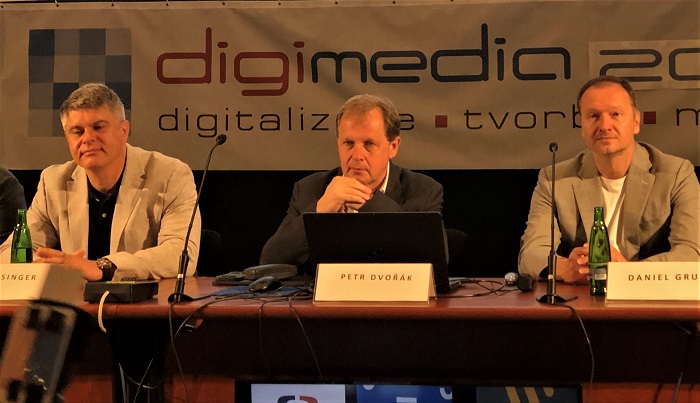
An increase in funding for Czech Television (ČT) through an increase in the television licence fee and other legislative changes that would redefine the television licence fee payer would, in the opinion of the largest commercial television groups, Nova and Prima, bring imbalance to the domestic television market. This was stated by TV Nova CEO, Daniel Grunt, and TV Prima CEO, Marek Singer, at Wednesday’s Digimedia 2023 conference.
The increase in the TV fee could be regulated by the “major media amendment”. However, it is questionable whether there will be political support for a fee increase. “We will see whether the opposition will block the law,” said Petr Dvořák, Czech Television’s CEO, at the conference. He told the participants that Czech Television’s estimates show that about 300,000 to 350,000 households do not pay the TV fee today, as they have stated in an affidavit that they do not own a TV set and thus do not use ČT services. If it were possible to change the definition of the licence fee payer to households that do not own a TV set but receive ČT services via digital platforms such as PCs or mobile phones, this would bring CZK 420 million per year to ČT’s budget.
Petr Dvořák described the proposal by ČT’s newly elected CEO, Jan Souček, that the fees should be paid by every household using electricity as a proposal made “long after the deadline”. If negotiations on the text of the amendment were to return to that point, the whole process would be significantly slowed down and the amendment would not be adopted until sometime around 2028, he said. On the other hand, he described the discussions on a new definition of a payer as advanced. It would basically build on the current definition and newly include users of ČT services on devices other than a TV set.
CEO of TV Nova, Daniel Grunt, said that a possible increase of the ČT fee to CZK 180 [the officially proposed sum is CZK 150, Ed.] from the current CZK 135 would bring Czech Television CZK 2 billion more together with the legislative redefinition of the fee payer. “This will create an uneven playing field for commercial players. ČT would have more in total than the commercial revenues of all commercial TV companies,” he said, adding that the public service function should be clearly defined.
Marek Singer, CEO of Prima Group, has also opposed the increase in TV fees. “Moreover, this does not mean that the CZK 2 billion increase will bring more new quality series and programmes. We are already competing for actors and writers and such an increase will only raise inflation on the market,” he added. At the same time, he believes that ČT would have to redefine the payer prospectively. And extending the definition to include users of ČT services on digital platforms would substantially solve the issue of ČT’s austerity scheme, he said. He therefore considers such a change “the least evil”, as he later clarified to MediaGuru.cz.
Czech Television and Czech Radio propose to increase the fee by CZK 15, i.e. to CZK 150 for ČT and CZK 60 for ČRo. As already mentioned, under the amendment to the Act on Television and Radio Fees, the fee should no longer be paid per TV or radio set, but the payer should be the one who uses the public service, i.e. including users of various internet platforms. At the same time, the principle of payment per household should be maintained.
According to Dvořák, the new definition of licence fee payers would mean an increase in the number of paying entities by 300,000 to 350,000. Together with the fee increase and the new method of calculating payment for companies, this would bring almost CZK 2 billion a year for ČT, while if the fee were increased by CZK 45, the annual benefit would be CZK 3.5 billion.
The latest example from Britain, but also other examples from Europe, show that piracy can be effectively detected but also condemned, writes Erika Luzsicza.
The British have cracked down on TV piracy in an exemplary way. They are setting the rules on how to deal with this type of crime. A group of five men who illegally streamed popular Premier League football matches were sentenced to a total of 30 years in prison. What may seem like a relatively trivial matter was actually a million-dollar business. The five were in fact selling access to watch at a rate of £10 per month. They made more than £7 million, or roughly £168 million. They managed to entice more than 50,000 subscribers and other resellers.
What is interesting is how the case was approached. The leader of the group was found guilty by the court of conspiracy to defraud, money laundering and also contempt of court. Overall, these are the longest prison sentences for piracy ever handed down in Britain. As highlighted by lawyers for the Premier League itself, the prosecutions were brought to protect some of the world’s most valuable content.
Harsh sentences have been handed out in the past – such as in 2019, when a trio of men were tried for illegally providing streaming services to more than a thousand pubs and clubs. Together they will serve a total of 17 years in prison.
Similar cases have been on the rise in recent years, across Europe. They show that piracy can be effectively detected but also condemned. The damage is enormous. The Premier League itself points out that the sale of copyrights makes a significant financial contribution to the entire football pyramid.
At the same time, these reports help to motivate other countries on how they can approach piracy and, where possible, crack down.
Czech Television’s stations continued to record a market share of over 30% this May and achieved the highest market share in the universal group over 15 years of age.
Czech Television stations also had the highest share of the TV market in May. Cumulatively, they reached 30.47% in the all-day broadcasting in the over-15 age group. The Nova group recorded the highest share in May in the prime time 15+ and also in the 15-54 and 15-69 audience groups in both daytime and evening broadcasts. This is according to official ATO-Nielsen measurement data.
The Prima group posted a full-day share of 27.18% in 15+ for May, finishing third strongest behind the TV Nova and CT groups by a few tenths. The Nova group, Television Seznam and Atmedia stations improved the most year-on-year.
May is traditionally a strong month for the sports channel CT Sport. The best performers year-on-year were Television Seznam (1.5% share in May, 15+), thematic channels of the Prima group – Prima Krimi, CNN Prima News, which exceeded 2% share (2.06%, 15+) and Prima Zoom, thematic stations of the Nova group – Nova Gold, Nova Cinema and Nova Lady. Compared to last May, the channel CT2, the main channel CT1, the station CT art and the main channel TV Nova also increased their share.
The most watched programmes in May were the series Specialists (Nova), Televizni noviny (Nova), hockey broadcasts (CT sport) and the series ZOO (Prima) and Cases of Marty the Extraordinary (TV Nova).
Piracy is now a major problem for the film and TV industry in Sweden. According to figures recently published by Mediavision, illegal downloading and streaming of films and series have increased for the second year in a row, with the problem being particularly widespread in younger target groups.
A quarter of all Swedes aged 15–74 say that they have downloaded or illegally streamed films or TV series in the past month. That is considerably more than during the same period last year, when the corresponding share was 20%. The problem is particularly widespread in the younger target groups, with more than half of those aged 15-24-year-olds admitting to being pirates.
The same survey also shows that illegal IPTV is increasing. According to Mediavision, close to half a million households in Sweden have this type of pay-TV service via the internet, which provides illegal access to a large number of TV channels and streaming services.
Commenting on the issue, Natalia Borelius, senior analyst at Mediavision, said: “piracy is a major challenge for the industry. It is particularly noteworthy that piracy is increasing and reaching such high levels among the young. We also note that an increasing number of households have illegal IPTV. Both these factors point at a continued increase if no action is taken”.
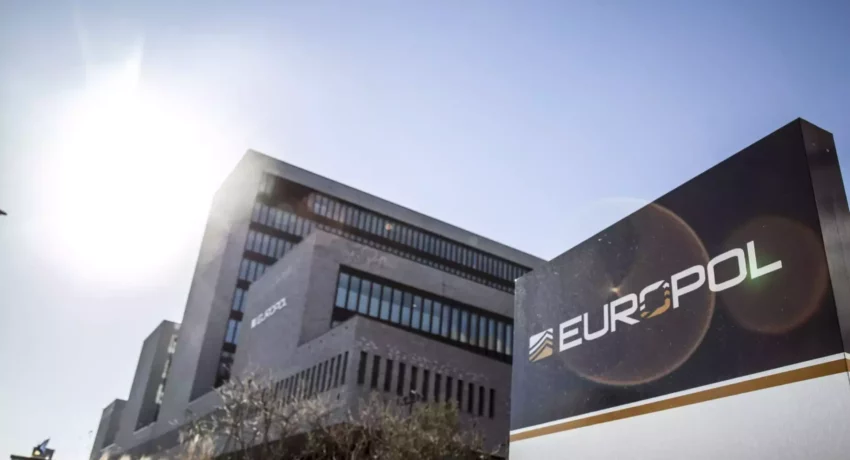
Europol has supported the Dutch Fiscal Information and Investigation Service (FIOD) in taking down an illegal IPTV service serving over one million users across Europe.
According to Europol, on May 23 a series of raids were carried out across the Netherlands as part of an illegal streaming crackdown. The officers from the FIOD searched properties in various locations in the country.
Several individuals were arrested on suspicion of involvement in the illegal streaming of premium content.
Packages bought by subscribers gave them access to over 10,000 live TV channels, alongside library of 15, 000 films and TV shows.
Europol adds that its European Financial and Economic Crime Centre supported this investigation with analytical support, helping identify the key targets and their criminal activity across Europe.
A number of operational meetings were organised by Europol to bring together the investigators in the different European countries affected by this criminal network.
Europol experts were also deployed in various locations in the Netherlands during the action day to support the FIOD in its enforcement activities.
The Association of Commercial Television (AKTV) wants foreign platforms like Netflix, HBO and Disney+ to contribute to the Audiovisual Support Fund in the same way as Czech services.
The domestic professional Association of Commercial Television (AKTV), which brings together the main commercial broadcasters on the Czech market, believes that the forthcoming amendment to the Audiovisual Act (Act 496/2012 Coll. on Audiovisual Works and Support for Cinematography) should level the market playing field and oblige international video-on-demand (VOD) operators to contribute to the Audiovisual Support Fund. This obligation currently applies only to domestic audiovisual on-demand service operators. “Although foreign platforms draw incentives and film here, they do not participate in the audiovisual support system. We want this to change,” said in an interview the president of AKTV, Klára Brachtlová, who is also the Chief External Affairs of the media group CME, the parent company of TV Nova.
Let’s start with your new role at AKTV, where you took on the role of president this year. In this context, you said that your priorities include the protection of copyright content and the involvement of commercial TV in the preparation of the amendment to the law on audiovisual. Is this still the case, or have any other priorities been added?
The short-term priority for us this year is definitely the transformation of the Cinematography Fund, while the fight against internet piracy is a key priority and an area that AKTV has been working on for a long time. So that has not changed and we expect intensive work and discussion. In my new role at AKTV, I intend to build on the work of my predecessors. AKTV celebrated its sixth anniversary this spring and in that time has become a relevant and respected association. What is new is that we will gradually want to expand our activities towards the wider public, whereas so far we have focused mainly on the professional public. One example is the educational content on our website on the topic of Internet piracy.
Let’s take a closer look at the two priorities you have set out. Let’s start with the amendment to the Audiovisual Act, which should include the transformation of the existing State Cinematography Fund into an Audiovisual Fund. At what stage are the preparations for the amendment of the law?
Firstly, it should be stressed that the amendment of the law is necessary. The Czech audiovisual industry now operates under legislation that is more than a decade old and in no way reflects what has happened on the market. I am referring primarily to the dynamic digitalisation of the media and the entry of foreign video platforms (VOD) into our market. Although the need for new legislation has been discussed for more than two years, the process of preparation is still at an early stage and has only been intensified since January this year. We shall see how quickly the preparations progress. According to the ambitious plan of the Ministry of Culture, the amendment should be ready by the middle of this year.
Regardless of the timing of the preparations, what do you consider essential for the amendment to deliver from the perspective of commercial broadcasters?
For us, it is absolutely essential that the amendment levels the playing field between foreign VOD platforms such as Netflix, HBO Max or Disney+ and domestic VOD platforms, but at the same time does not upset the delicate balance that currently exists in the market. At the moment, the obligation to pay fees to the existing Cinematography Fund applies only to Czech entities, i.e. Voyo and now also to the Prima+ service. Domestic audiovisual media service providers pay 0.5% of their revenues annually. Although foreign platforms receive incentives and film here, they do not participate in the audiovisual support system. We want this to change.
Do you have a more concrete idea of how much multinational providers should contribute to the fund?
We believe that it would be enough to unify the conditions for domestic and foreign platforms. Domestic VOD platforms contribute 0.5% of their annual revenues, which should also apply to foreign ones. Many European countries have solved this in this way. Thus, it would be sufficient to add to the law in the relevant section that the 0.5% fee also applies to international providers. I do not think it is necessary to increase the percentage paid in support. Just by getting more entities involved in support, the levies would be multiplied. Moreover, the VOD market in general is growing rapidly, further increasing the amount of money paid in. In discussions at the Ministry of Culture, there have been proposals for a 2% levy, which we do not agree with. This is a leapfrog increase, and we do not like it. There is also consideration of introducing into the levy a mandatory obligation for foreign platforms to reinvest part of their revenues in the Czech Republic in the form of direct investment in Czech content.
This form of reinvestment is supported by Czech producers. How do commercial TV players feel about it?
I have been working in commercial entities all my life and therefore have a strong attitude towards such a proposal. I very much respect the conditions of the free market, which is why I don’t think it’s a good idea for the state to interfere in any way with how a commercial entity should handle its profits. I consider that to be the wrong way to go. We know that the possible reinvestment requirement is based on a recommendation from the European Union, but it is not the duty of Member States to introduce it.
TV Nova’s parent company, CME, and Prima, which launched Prima+ this year, all agree that they are investing the most in original local production in their history. By how much has the introduction of VOD platforms by these entities increased the cost of content production?
If I simplify it, it will be multiples of the investments made in previous years. On Voyo Original alone, it’s hundreds of millions of crowns a year extra that are being put into premium Czech productions.
In your opinion, what else should the amendment contain?
Part of the changes to the law would include extending support from cinema to the entire audiovisual industry, and therefore, in addition to cinema, to so-called small screens, which includes video platforms. This is therefore one area where the Fund’s resources are being spent. The second part of the Fund is incentives. Until now, there have been certain obstacles that have prevented Czech entities from applying for incentives. For example, setting the minimum price per episode of a work at CZK 8 million. Commercial entities can produce such an episode more efficiently and for less money, and this setting alone is an obstacle to Czech entities reaching for incentives. One year it happened that three foreign projects used up almost the entire budget of the fund. This is also absurd given that foreign platforms do not pay taxes in this country and do not contribute to the fund.
The current law on cinema support also obliges you, as a commercial TV entity, to pay 2% of your annual advertising revenue to support Czech cinema. With Nova gradually launching the Voyo video platform and Prima launching the Prima+ online service this year, you must pay the levy twice as a single operating entity…
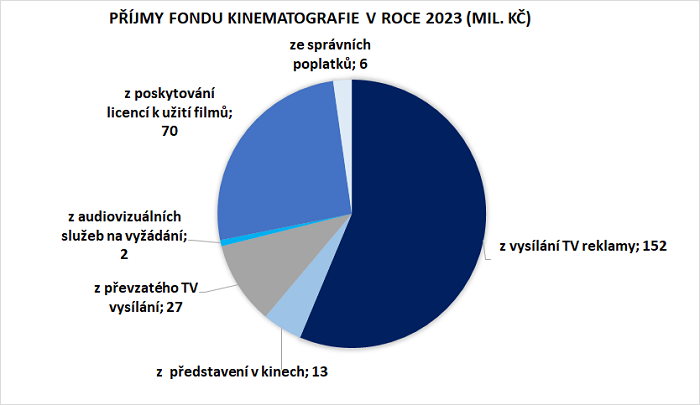
Yes, we pay for each service separately. So TV Nova pays as a linear TV broadcaster from advertising revenue and also as a provider of the Voyo pay VOD platform. The TV stations are the biggest payer and pay around CZK 150 million to the Fund every year. With the envisaged transformation into an Audiovisual Fund, support could be directed not only to works intended for cinemas, but also to projects for VOD platforms and TV.
Income of the Cinema Fund in 2023 (in millions CZK); Source: State Cinematography Fund budget for 2023
And is it possible that you could also qualify for support?
Hard to say. The concept of the fund will be approved by the board of directors, which will have 15 members, in which we as taxpayers can have one or two votes. The specific projects will then be decided by the boards. So we will have no influence on which projects the fund will support.
In terms of content protection activities, specifically the fight against pirated content, do you feel that it is moving for the better?
Of course, the Copyright Act gives us some protection, and we welcomed its recent amendment. But the problem is the actual enforcement, which unfortunately still does not work as the legislator intended. The courts do not have sufficient expertise, are slow and interpret the law in a very formalistic way. When a platform that distributes our content without a licence purposely identifies itself as a cloud storage platform and claims that it does not provide any content itself, the law is short on that. Although the situation is slowly moving, the overall situation in the Czech Republic is not ideal. The fight against online piracy is costing us a huge amount of time and resources and depriving not only us, but the entire creative and cultural industry of considerable resources. We have no doubt that this is a distortion of market conditions and unfair competition. Unless there is local political will and the courts follow the recommendations, not much will change. One possible solution would be to amend the aforementioned Audiovisual Act, which could come up with a solution to deal more conceptually and out of court with platforms with illegally shared content. Possible amendments to civil or criminal law could also help. Such repositories have already disappeared abroad, so we believe that the situation here will gradually improve. Moreover, the number of people paying for online content in our country is increasing as legal content becomes more accessible.
KLÁRA BRACHTLOVÁ: She has been President of AKTV since the beginning of 2023, and at the same time, she was appointed to the position of Chief External Affairs of CME, the parent company of TV Nova. She has worked in the finance section of the Nova Group since 2007. She held successive positions in reporting, financial planning and analysis, from 2012 she was Deputy CFO, from 2014 CFO, later Managing Director and from 2019 CEO of TV Nova.
The Alliance for Creativity and Entertainment (ACE) has shut down Spain’s top illegal streaming and torrent service, AtomoHD.
According to ACE, AtomoHD was launched in 2020 by a group of individuals, some of whom had prior convictions in Spain for intellectual property infringement and to evade justice, fled to Andorra. AtomoHD enabled users to illegally stream and download content from a VOD library of more than 13,000 movies and 4,500 TV series in Spanish and other languages. The pirated content impacts all ACE members.
Since its inception, the site logged 235 million visitors, averaging 9.7 million monthly visits and 484,000 unique visitors. Ninety percent of the online traffic originated in Spain, followed by the US, Germany, and France. AtomoHD was operating via 60 website domains.
Commenting on the development, Jan van Voorn, executive VP and global content protection chief of the Motion Picture Association and Head of ACE, said: “This takedown represents yet another major victory by ACE over illegal content distributors.
“It is increasingly clear that major criminal operators like AtomoHD are not immune from ACE’s enforcement actions”.
The domains are being transferred to ACE and will be redirected to the “Watch Legally” page of the ACE website.
Local video platform Voyo will continue its set pace of investment in content production in the coming years. “The mathematics of the growth trajectory does not allow us to slow down,” says CME deputy CEO Dusan Švalek.
Central European Media Enterprises (CME), the parent company of TV Nova, is confident in the set strategy of its pay video platform Voyo and will continue with it. It sees its entry into the market as successful and expects Voyo to grow with the entire SVOD market in the Czech Republic and Slovakia. It predicts this will double by 2027. Voyo’s subscriber base now exceeds 500,000 in the Czech Republic and Slovakia and it wants to reach one million by 2025.
In a discussion with journalists, you presented estimates for the development of pay video on demand (SVOD) in the Czech Republic and Slovakia on behalf of the CME Group. They showed that you are optimistic and expect continued rapid growth in SVOD. Is it really realistic for Voyo to reach one million subscribers in both countries by 2025? On the contrary, are you not worried that growth will slow down after the initial rapid growth?
We firmly believe that we will reach that goal, although it will not be easy. We are basing this on several assumptions. Firstly, we see from developments in foreign markets that it is possible to reach that number of subscribers. We have seen it in America, Scandinavia, Britain, so our ambition is based on an estimate of where the Czech market can go. Secondly, we believe we are well on our way. We were the first of the local players to enter the market and have made significant investments. They pay off after some time, plus new things are coming in and everything builds on the other. Sequels are coming to series that viewers already know and talk about with friends and acquaintances, and that helps to further expand the user base. Third, we trust our team. We’ve brought in a number of great people with a wide range of expertise. These are people who understand content production, video and digital media and bring a completely different perspective. It’s the digital part that we’re expanding the most.
Does the data you have show you the differences between the TV Nova or TV Markiza audience and the Voyo audience?
Yes, we see that Voyo viewers are a little bit younger than the viewers of linear TV channels. This reflects that the technological adaptation of the new way of consuming video is easier for the Internet generation. I’m not saying it’s a rule, but it started there, and thus the ratio is a bit higher.
You also talked about Voyo’s heavy investment in content as a necessity for such a service to compete with multinational players. Will you continue to invest in Voyo as much as you have been, or do you foresee more use of the archive in the future?
As far as the library of titles is concerned, it will certainly have some value, there are already 2,000 films in it, for example. And we keep buying because we believe there is room to build the library even stronger and that our viewers will return to it repeatedly. And add to that our own titles, both for linear broadcast and directly for Voyo, like Iveta or Král Šumavy (King of the Bohemian Forest), which are ageless and have high production value. Our ambition is to create quality stuff – premium video content.
We definitely want to keep up the pace of investment for the period we are projecting now. Because the math of the growth trajectory doesn’t allow us to have a lower pace. It’s important that we see a return on investment at the end of the journey. Mainly so that we can reinvest the profits back into producing new titles and new content.
How do you calculate the return? Through monetization of subscribers or also through advertising in linear broadcasting, where some Voyo titles also appear or appear later?
That depends on exactly how we allocate content on a channel-by-channel basis. The bulk of the titles will only be on Voyo and it’s relatively straightforward there. Some titles go on Voyo first and with some delay to linear TV – most often a week in the case of series previews and our entertainment shows, and some titles only appear with more time. But that decision is still to be made as to what mix we will choose and whether we will want to put more shows from Voyo into linear TV. We put the first truly Voyo Original Případ Roubal (The Roubal Case) on Voyo towards the end of 2021 and you still couldn’t see it on TV.
The return on investment is projected for 2025?
As Didier Stoessel (CEO of CME, ed.) said, we are already approaching the payback in this period.
According to your estimates, the number of households using SVOD in the country will double by 2027. How will this growth be reflected in the number of Voyo subscribers? How many might it have in 2027?
I wouldn’t like to speculate on that. Our ambition is to deliver the best local SVOD service. We are building on local content and we want to lead the market and be the number one choice for users to watch local content. All numbers, market shares and quantitative targets are based on this core strategy.
From the beginning, you have profiled Voyo as an ad-free platform. Isn’t that closing the door to more subscribers and to some of the revenue you would have earned by selling advertising?
This is a question of the focus we have chosen. We might have gained some customers by introducing a hybrid model, but we would also have lost many of them. Because if you’re going to introduce something like that, you need to focus on it, you need to support it and promote it. Every company with big ambitions has to choose its battlefield. Our battleground for this growth phase is a paid service with no advertising, and we’re putting all our resources into it, setting the mentality, customizing the product. We believe it’s the best we can do for this stage of market development. And we have the data to back us up: the top five benefits of Voyo include being ad-free.