OMDIA STUDY: FROM REACTION TO PREVENTION – HOW VIDEO CONTENT PROTECTION AGAINST PIRACY IS EVOLVING

Identifying a pirate stream, requesting its removal and taking action against its operator remain important parts of content protection. In the era of illegal live streaming, however, a purely reactive approach often comes too late. Omdia’s study Next-Generation Anti-Piracy for TV and Video: Why the streaming era demands a shift from reaction to prevention therefore recommends complementing traditional content protection mechanisms with preventive tools capable of stopping some attacks before content reaches illegal distribution channels.
Omdia’s July 2026 study points out that protection based solely on detecting and removing illegal content after it has appeared can no longer keep pace with modern piracy. The objective should therefore not be to abandon traditional protection measures, but to complement them with security mechanisms capable of stopping some attacks earlier in the content distribution chain.
Reactive protection only intervenes after an attack has begun
Anti-piracy efforts have traditionally been largely reactive: illegal content first had to be detected, followed by a takedown request and, where necessary, further legal or technical action. This approach still has an important role to play, but Omdia notes that modern forms of piracy are able to exploit its limitations. According to the study, individual traditional protection methods have their own weaknesses:
- Conditional access systems (CAS) can be circumvented, for example, through access-card cloning or key sharing.
- DRM protects digital content against unauthorized playback, but video can still be captured once it has been legitimately decrypted for viewing.
- Illegal-content takedown requests are constrained by speed: content may be republished before the original copy has even been removed.
- Enforcement by platforms, app stores and internet service providers can shut down a pirate service, but its operations may simply move elsewhere.
- Real-time monitoring of pirate streams detects theft only after it has already begun. In the case of live sports, enforcement may therefore come too late.
Each of these tools consequently has limitations that pirates can exploit. Reactive measures also face a fundamental constraint: time. Intervention only takes place after content has already begun to circulate illegally. According to Omdia, this is precisely why reactive measures need to be complemented by preventive protection.
Today’s attacks target more than the video itself
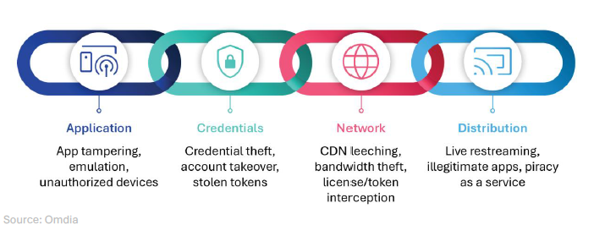
Modern piracy can target several parts of the distribution chain at the same time, including applications, credentials and the infrastructure through which content is delivered to viewers. Protecting the video itself is therefore no longer sufficient.
One prominent example is the abuse of a content delivery network (CDN). An attacker may obtain a valid access token—a digital credential authorizing access—and use it to retrieve a stream directly from the legitimate service provider’s infrastructure. Protection mechanisms must therefore verify not only whether a user is entitled to view the content, but also whether the request genuinely originates from an official, unmodified application.
image Source: Omdia
Some attacks need to be stopped before content is distributed
The fundamental shift is that service providers should not simply wait until content has been stolen and then attempt to trace and remove it. Some attacks can be stopped at the point where an attacker attempts to gain access to the content.
Omdia highlights four key elements of next-generation content protection:
- Multi-DRM – manages encryption and authorized playback across different devices and DRM technologies.
- Forensic watermarking – makes it possible to trace the source of a leak and target subsequent enforcement more precisely.
- Application security – detects and blocks unauthorized modifications to applications or the misuse of access credentials.
- Application attestation – verifies that content requests originate from a legitimate, protected application and helps prevent the misuse of credentials and distribution infrastructure.
Multi-DRM provides the fundamental layer of protection, while forensic watermarking primarily serves a reactive function. Application security and attestation, by contrast, move content protection further towards prevention.
DRM remains a cornerstone of protection, but is not sufficient on its own
Modern Multi-DRM systems make it possible to centrally manage encryption and licensing across different DRM technologies and device types. They therefore provide a fundamental protection layer in an environment where service providers distribute content across a wide range of platforms.
However, comprehensive protection must also cover the application itself, access to content and communication with backend systems.
Forensic watermarking helps identify the source of a leak
Forensic watermarking embeds identifying information into video content, making it possible to trace a specific leak back to its source. A watermark does not prevent theft by itself, but it helps determine where an illegal copy or stream originated and enables subsequent enforcement action to be targeted more precisely.
Omdia also notes that some watermarking methods have limitations, particularly in live broadcasting. Where identifying information is inserted directly by the user’s application, the reliability of the protection also depends on the security of the application itself. The individual layers of protection are therefore interconnected.
The application itself is becoming part of the security perimeter
As streaming has developed, some security functions have moved directly into applications running on devices that are not controlled by the service provider. According to Omdia, code obfuscation alone is not sufficient. Applications must also be protected against unauthorized modification and the misuse or manipulation of communications with backend systems.
An additional protection layer is provided by access control and client application attestation. The system verifies not only the user’s entitlement, but also whether the request originates from an official, unmodified application. This can help block modified applications, misuse of access credentials and unauthorized retrieval of streams from the CDN. Protection therefore intervenes before the content reaches illegal distribution channels.
Prevention is not intended to replace reactive measures, but to make them more effective
According to Omdia, preventive and reactive protection are not competing strategies. If application security and access-control mechanisms stop some attacks in advance, fewer attacks progress to the stage of illegal distribution. Reactive tools can then be deployed in a more targeted and effective manner.
The key change is therefore one of defensive logic: stop what can be stopped in advance; rapidly identify what gets through; and remove content that reaches illegal distribution channels as quickly as possible.
No security mechanism remains effective indefinitely without change
Omdia also stresses that no security mechanism can be considered permanently unbreakable. Attackers can gradually analyze DRM systems, forensic watermarking and application protection mechanisms and look for ways to circumvent them. The ability to continuously modify and renew protection mechanisms is therefore critical.
Security thus becomes an ongoing process rather than a one-off measure. The faster a service provider can update its protection mechanisms, the more difficult it becomes for attackers to repeatedly exploit a vulnerability they have already discovered.
From protecting the video to securing the entire distribution chain
Omdia’s final recommendation is therefore not based on any single technology. Service providers should assess whether their existing protection measures can withstand current attack methods—particularly CDN abuse, credential misuse and attacks targeting applications—and complement traditional reactive content-protection tools with preventive security layers. The objective is no longer simply to find and remove a pirate stream as quickly as possible. Increasingly, the priority is to stop the attack before the content reaches illegal distribution channels.
About the study: Next-Generation Anti-Piracy for TV and Video: Why the streaming era demands a shift from reaction to prevention was published in July 2026 by technology research and advisory firm Omdia. It was authored by Rob Gallagher, Principal Analyst for Consumer Technology and Services, and Rik Turner, Principal Analyst for Cybersecurity. The study was commissioned by Verimatrix and, in addition to examining how piracy is evolving in the streaming era, explores why the authors believe traditional reactive content-protection tools increasingly need to be combined with preventive security mechanisms. The analysis draws on Omdia’s ongoing research across television and online video, digital content, consumer behaviour, cybersecurity and enterprise technology. The consumer data used in the study includes an online survey conducted in November 2025 among 21,806 people aged 18–64 in Australia, Brazil, France, Germany, Japan, Mexico, Spain, the United Kingdom and the United States. Data on the reasons for using unauthorized video services is based on responses from 4,499 respondents across the same nine countries.