NIELSEN ‘BLIND SPOT’ GETS A LITTLE BLINDER, WILL CEASE MONITORING MANY TV MARKETS

Nielsen late last week began informing clients that, effective March 31, it will discontinue monitoring ads on TV in 137 markets. The news comes on the heels of Nielsen’s decision to also discontinue its radio advertising monitoring service – SIGMA Radio – ad the end of the month, something some sources see as cost-cutting moves as Nielsen focuses on the bigger, more complex issues associated with the overhaul of its national Big Data + panel audience measurement service, which more of less still is the national currency for TV advertisers heading into this year’s upfront advertising marketplace.

The 137 markets Nielsen is ceasing to monitor ads in are so-called “RPD+” markets relying on return path data from cable and satellite TV providers (Dish, DirecTV, Comcast and Charter) for measuring viewers in what generally are smaller TV markets. The 137 markets previously used paper diaries to measure demographics and audience composition, but Nielsen made the conversion to “electronic measurement” in the fall of 2019.

“As Nielsen continues to evolve its local TV measurement strategy to prioritize Big Data integrated with a representative panel, we are updating our operational workflows to reflect the primary measurement drivers in the marketplace,” Nielsen said in the notice sent to clients late Friday,, adding, “While our local panels remain a critical component for representing “blind spots”—such as over-the-air (OTA) homes – the reliance on a dedicated Nielsen backup system (like audio signatures) has decreased as our methodology has evolved.”

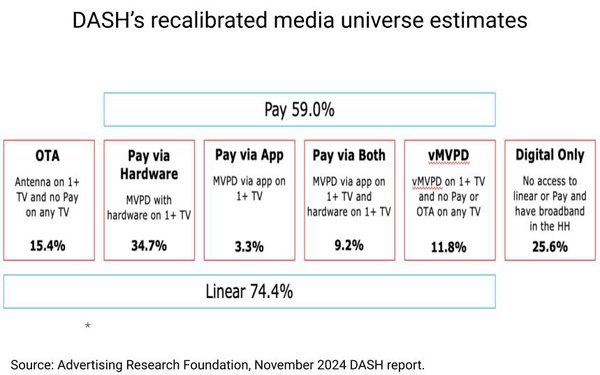
The use of the term blind spots is noteworthy, because Nielsen recently began recalibration the universe estimates it uses as the basis of its TV measurement systems based on highly-regarded third-party research, the Advertising Research Foundation’s DASH service.

According to recent estimates published by DASH, OTA – households still using an antenna to receive their TV via a broadcast signal – represents more than 15% of the total TV universe, and more than 20% of the linear TV universe, excluding digital-only TV access.

“Adjustments were made to The Gauge in July 2025 to account for unmonitored stations, ensuring broadcast network and syndication program viewing is accurately captured,” Nielsen noted in the client notice, but it didn’t detail exactly what those adjustments were, or how they were derived.

Nielsen began recalibrating its estimates based on DASH data at the end of January 2026 and its updated estimates will be published in the March edition of The Gauge on March 24 – a week later than normal – representing a readjustment of its February total day TV usage data.

Ad for advertisers, agencies and stations that previously relied on Nielsen’s active commercial monitoring in the 137 TV markets, Nielsen said they will have to rely on stations actively “self-monitoring” their watermarks.

“The impact: If a station’s watermark fails on a feed we are no longer actively monitor and the station is not self-monitoring, they will not receive credit for the panel-based position of their audience (ie. OTA homes,” Nielsen explained.

The primary customers for Nielsen’s TV commercial tracking service are commercial, direct response and public service announcement (PSA) advertisers and their agencies.

The notice goes on to recommend stations “regularly verify” the presence of Nielsen’s watermarks in their on-air feeds or purchase “third-party encoding monitors” to do so.

Source: mediapost.com

ILLEGAL LIVE SPORTS STREAMING FLOURISHING DESPITE INDUSTRY CRACKDOWNS

Ahead of next month’s Super Bowl LX, which NBCUniversal’s Peacock streaming service hopes will be its largest-ever live viewership (along with the Winter Olympics in Milan, Italy), there is growing concern about the rise in streaming sites offering illegal access to live sports.

A 2025 study found that 69% of sports fans in the United States and Europe have turned to illegal streams as the subscription cost of their platforms rise. In the United Kingdom, approximately 4.7 million adults (9%) confessed to using illegal streams for sports.

Worse still, 58% of sports fans in the United Kingdom now consider illegal streaming to be “socially acceptable,” according to new data from Nielsen — viewing it as a response to an overpriced and complicated legal market to access their favorite teams.

Illegal sites in the United Kingdom, which showcase soccer, boxing, tennis, cricket, as well as movies and TV shows, reportedly attracted 1.6 billion views in the first half of 2025. Analysts contend the trend could see sports leagues worldwide lose upwards of $28 billion annually in revenue due to piracy.

In addition to revenue loss, illegal live streams pose a risk to the end user. A study by OpenText Security Solutions found that nearly every illegal streaming service exposed users to malicious or misleading content, including malware, spyware, phishing, junk security software, explicit content, fake operating systems and related online scams.

The NFL, NBA and UFC have urged the U.S. government to update the Digital Millennium Copyright Act (DMCA). They argue that live sports are uniquely vulnerable because their value depreciates instantly after the event ends, requiring faster, “real-time” takedown powers.

In 2023, Peacock and EverPass, a media platform distributing live sports and entertainment content to commercial businesses, created Peacock Sports Pass to discourage individual third party subscribers from using personal subscriptions at commercial businesses.

“Accessing ‘NFL Sunday Ticket’ and Peacock sports content in commercial establishments such as bars, restaurants, and other businesses through unauthorized channels and residential subscription services (a Peacock subscription) or other unauthorized third-party platforms is unlawful,”

EverPass wrote in a post.

The Alliance for Creativity and Entertainment (ACE), whose members includes Amazon, Disney, Netflix, Paramount and Warner Bros. Discovery, last month hailed the shutdown of the pirate site Streameast, calling it a “resounding victory” for the entire live sports ecosystem.

“Piracy isn’t a harmless shortcut as it exposes consumers to real risks and drains resources from India’s creative economy,” Larissa Knapp, EVP and chief content protection officer at the Motion Picture Association, said in a statement. “Our actions make clear that ACE will relentlessly pursue and dismantle illegal operations so audiences and creators can benefit from a secure, sustainable marketplace.”

X, YouTube, Facebook, Instagram and TikTok all say that they remove illegal content streams from their platforms as soon as they are made aware of it.

Source: mediaplaynews.com

OUT-OF-HOME VIEWING REACHED SEVEN PERCENT IN FEBRUARY

Total television viewership in February increased by ten per cent year-on-year. The inclusion of out-of-home viewership measurements contributed significantly to this increase. As a result, daily viewership is higher by an average of 17 minutes.

Out-of-home television viewership accounted for seven per cent of total television viewership in February. On average, this amounted to 17 minutes per day out of a total of 4 hours and 11 minutes that viewers aged 15 and over spent in front of the television screen. This is according to the first complete data since the introduction of the new unified TV currency, which since 1 February also includes out-of-home viewing. This was reported by Atmedia, citing official ATO data.

The share was even higher in commercially key target groups. It reached 10 per cent among viewers aged 15-54 and 9 per cent among those aged 18-69. According to Atmedia, viewing outside the home is most prevalent among viewers under 34.

Total television viewership in February increased by 10% year-on-year. According to Michaela Suráková, managing director of Atmedia, the significant growth is mainly due to the inclusion of out-of-home viewing, which accounted for roughly four-fifths of the year-on-year increase. “Even without it, however, television viewership in February increased year-on-year. The Winter Olympics, which traditionally attract a large number of viewers to their television screens, played a role,” she said.

The first complete monthly data also confirm that out-of-home viewing is particularly important for certain thematic channels. Music channels reported above-average figures – for example, the Rebel channel had a 14 per cent out-of-home audience share among viewers aged 18–69. Documentary and children’s channels, such as Discovery Channel and Disney Channel, also recorded higher shares.

Sports channels play a specific role, as their content is traditionally watched in restaurants and sports bars. The February data was significantly influenced by the Winter Olympics in Milan and Cortina d’Ampezzo. According to Atmedia, Eurosport 1 reached 1.7 million viewers aged 4 , almost three times as many as during the Winter Games in Beijing four years ago. Among viewers aged 18–69, viewing outside the home accounted for ten per cent of the channel’s total viewership.

Source: mediaguru.cz

THE ILLEGAL STREAMING SERVICE BITPLAY HAS BEEN SHUT DOWN

The pirate service Bitplay, which, among other things, illegally provided access to premium sports television channels, live broadcasts of sports matches and selected series content, has been shut down. The service was shut down following a criminal complaint by the Association of Commercial Television (AKTV) and a subsequent investigation by the Czech Police.

The Association of Commercial Television Stations identified the pirate service Bitplay in mid-2025. Given that the operator did not cease its activities despite warnings from the legitimate copyright holders, the association’s members decided to take legal action against the operator. Together with its supplier, Warezio, which monitors the occurrence of illegally shared television content for television broadcasters, AKTV prepared evidence on the basis of which the law enforcement authorities identified the operator as a natural person.

The Bitplay service, operating on the domains bitplay.my, starstreams.pro, starsites.fun and starlive.click, offered access to premium paid sports channels and broadcasts without the relevant licences from the rights holders. The service was promoted through social networks and other online channels and targeted Czech, Slovak and Polish users.

“Illegal streaming harms broadcast rights holders, sports competition partners, and athletes and sports clubs themselves. Investment in quality content is only possible in an environment where copyright is respected and protected,” said Marek Singer, president of AKTV. “The action against Bitplay is another step in our systematic approach to combating the illegal distribution of our content. We will continue to actively take action against entities that unlawfully offer and monetise protected content.”

In addition to the damage caused by piracy to copyright holders, the use of illegal services also poses a security risk to users. The biggest problem may be the misuse of personal or payment data, but also the unintentional downloading of various malicious software (viruses, malware, spyware, and more).

In addition to actively protecting copyrights, the Association of Commercial Television Stations has long focused on educational activities. As part of these activities, it operates an information website on copyrights, which is available at NormalneLegalne.cz. Here, interested parties will find a directory of legal sources, a glossary explaining terms related to intellectual property protection, answers to frequently asked questions (FAQ), and regular news focused on internet piracy.

THE ILLEGAL STREAMING SERVICE BITPLAY HAS BEEN SHUT DOWN

The Bitplay piracy service, which, amongst other things, unlawfully made premium sports TV channels, live sports broadcasts and selected TV series content available, has been shut down. The service was shut down following a criminal complaint lodged by the Association of Commercial Television Broadcasters (AKTV) and a subsequent investigation by the Czech Police.

The Association of Commercial Television Broadcasters identified the Bitplay piracy service in mid-2025. Given that the operator had failed to cease its activities despite receiving notices from the legitimate copyright holders, the association’s members decided to take legal action against the operator. Together with its supplier, Warezio – a company that monitors the occurrence of illegally shared television content on behalf of television broadcasters – AKTV prepared evidence on the basis of which the law enforcement authorities identified the operator as a natural person.

The Bitplay service, operating on the domains bitplay.my, starstreams.pro, starsites.fun and starlive.click, offered access to premium paid-for sports channels and broadcasts without the relevant licences from the rights holders. The service was promoted via social media and other online channels and targeted Czech, Slovak and Polish users.

“Illegal streaming harms broadcast rights holders, partners of sporting competitions, as well as the athletes and sports clubs themselves. Investment in high-quality content is only possible in an environment where copyright is respected and protected,” said Marek Singer, President of AKTV. “The action taken against the Bitplay service is a further step in our systematic approach to combating the illegal distribution of our content. We will continue to take active measures against entities that unlawfully offer and monetise protected content.”

In addition to the harm caused to rights holders by piracy, the use of illegal services also poses a security risk to users. The biggest problem may be the misuse of personal or payment details, but it could also involve the inadvertent downloading of various types of harmful software (viruses, malware, spyware and others).

In addition to actively protecting copyright through legal means, the Association of Commercial Television Stations has long focused on public awareness campaigns. As part of these activities, it runs an information website on copyright, available at NormalneLegalne.cz. Visitors will find a directory of legal resources, a glossary explaining terms relating to intellectual property protection, answers to frequently asked questions (FAQs) and regular news updates focusing on internet piracy.

FIRST DATA: OUT-OF-HOME VIEWING INCREASED THE RATING OF TOP OLYMPIC BROADCASTS BY 13%

Extended ATO measurement provided the first hard data on how watching broadcasts “outside the home” can increase the overall television rating of a major sporting event. Broadcasts from the 2026 Winter Olympics showed that outside-the-home viewing increases the reach of the most-watched sports broadcasts by up to 13 per cent.

The 2026 Milano Cortina Winter Olympics provided the first concrete figures on how significantly out-of-home (OOH) viewing can increase television broadcast reach in the Czech environment. Data from the Association of Television Organisations (ATO), provided to MediaGuru.cz by Czech Television, shows that the most-watched broadcasts attracted more than 200,000 additional viewers.

On 1 February 2026, the ATO officially expanded its television audience measurement to include data from the ReDAM mobile panel. In addition to traditional people meter measurement in households (PCEM), it now also includes viewing of television content outside the home, i.e. in restaurants, holiday cottages, waiting rooms and other public spaces.

Hockey added over a quarter of a million viewers

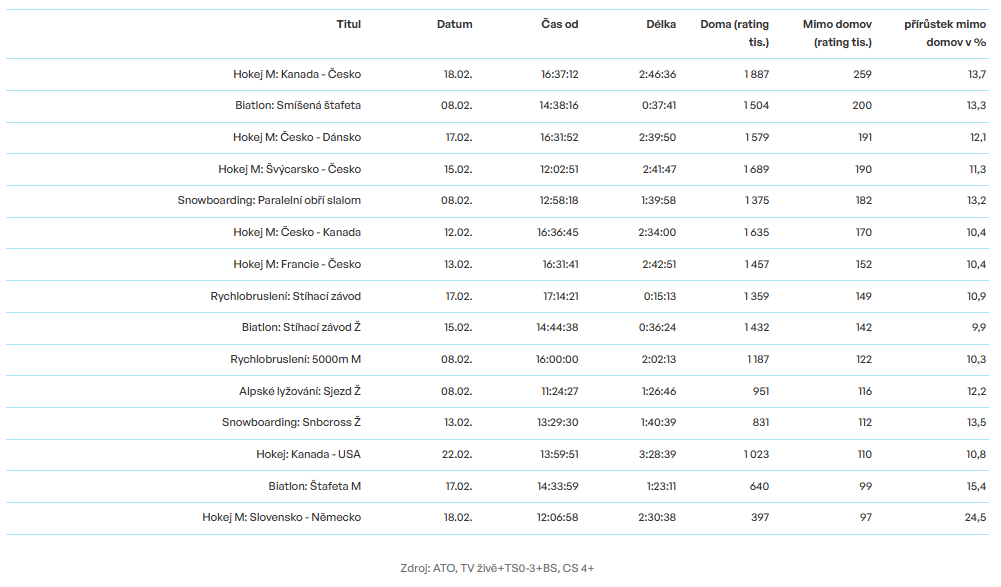
The most watched broadcast of this year’s Winter Olympics on ČT sport was the Czechia-Canada ice hockey match on 18 February. It was watched by 1.89 million viewers in households and another 259,000 outside the home. Viewership outside the home thus represented an increase of more than 13%.

Other hockey broadcasts also made a similarly significant contribution to OOH. The Czechia-Denmark match added almost 191,000 viewers outside the home (12.1%), while the Switzerland-Czechia match added another 190,000 (11.3%). Other sports also exceeded the threshold of 150,000–200,000 viewers outside the home, such as the biathlon mixed relay (200,000, 13.3%) and the parallel giant slalom in snowboarding (182,000, 13.2%).

TOP 15 broadcasts of the 2026 Winter Olympics on ČT sport

The increase corresponds to ATO estimates

Before the launch of live broadcasting, ATO estimated that including out-of-home viewing could increase total viewership by 6 to 10%. Data from the Winter Olympics show that for premium sports broadcasts, the increase is even higher – most often between 10 and 14%, and in one case even over 24% (for the less-watched Slovakia-Germany ice hockey match, where the relative increase was influenced by lower domestic viewership). On average, the TOP 15 most-watched broadcasts saw a 13% increase in ratings.

Sports content thus confirms that this type of programme has significant potential for collective viewing in public spaces. Restaurants, sports bars and fan zones become an important distribution channel for television coverage during major events.

The inclusion of mobile measurement provides the television market with a more realistic picture of overall reach. Especially for sports broadcasts, the share outside the home can be significant. For broadcasters and advertisers, this means a more accurate calculation of actual reach.

Source: mediaguru.cz

PRIMA WANTS THREE BIG REALITY SHOWS A YEAR, ALSO LOOKING FOR A RELATIONSHIP SERIES TO REPLACE POLABÍ

With approximately 300,000 subscribers, the prima+ platform is still in a growth phase. Jan Maxa, the new Content and Production Director at the Prima Group, describes how he plans to connect the development of programmes for linear broadcasting with prima+, and what is coming up in the near future.

On 1 February, Prima adjusted its organisational structure and, as part of the changes, created a new Content and Production division. This move unified the content strategy, development, and production across the group. The division is headed by Jan Maxa, who until then had been in charge of Prima’s VOD segment.

In the interview, he describes how he wants to connect the development of programmes for the linear broadcasting of TV Prima with prima+, how projects are divided between television and VOD, and how their monetisation is structured today. He also talks about plans for new series and reality shows, the programming strategy in prime time, the economic performance of the streaming service, and the differences between public-service and commercial television production. “We are continuously working on dozens of new projects, and viewers can look forward to at least one new premiere programme on prima+ every month,” he explains.

You have recently taken on a new role within the Prima Group, in which you are responsible for the development of programmes for both linear broadcasting and prima+. What exactly does this position entail?

I lead the newly established Production and Content division, which includes the entire production under the leadership of Lucie Kršáková, the scripted series development section headed by Lenka Hornová, the development of reality and entertainment formats led by Samo Jaško, as well as dubbing and the archive. One part of the division is still being staffed. At the same time, I continue to focus on content for prima+.

Prima+ is now temporarily led by CEO Lukáš Kubát. How have you divided your responsibilities?

Lukáš Kubát focuses primarily on the business side and the platform’s strategy, while I am responsible for the content. Together, we try to connect these two areas as effectively as possible so that the content and the business goals support each other.

What does that mean for the development of programmes? How do you plan to divide them between linear broadcasting and VOD?

Our content strategy is built so that some projects are created primarily for linear broadcasting. In drama, this mainly includes long-running or multi-season series, while in entertainment, it involves classic television formats such as talk shows or competition shows. On prima+, these titles appear as weekly previews in the paid version and later as catch-up in the free version.

In addition, we create content primarily for prima+, especially large reality formats, new drama and true crime series. We are gradually expanding the genre spectrum to include documentary and factual projects. These programmes may later appear on linear broadcasting with a certain delay, depending on how they fit into the programming schedule. The rollout is therefore flexible, and we adapt it to each title and the needs of both platforms.

What is the usual time gap between a programme’s release on prima+ and its subsequent broadcast on television? For example, this spring, the series O lidech a koních is heading to linear broadcasting, having premiered on prima+ eight to nine months ago.

The standard gap can vary depending on the specific project, but generally it ranges from six to eighteen months. Ideally, the timing would be more than a year. However, each project is approached individually.

The standard gap between a programme’s release on prima+ and its subsequent broadcast on television can vary depending on the specific project, but generally ranges from six to eighteen months.

Given that prima+ has several content packages depending on how the content is handled, the question is how the project monetisation is structured. Can you combine titles created primarily for prima+, which generate revenue only from user subscriptions, with later linear broadcasting in a way that ensures a positive return?

Monetisation for linear broadcasting is relatively straightforward. The source of revenue comes from the GRPs generated, which are sold to advertisers. For a paid VOD platform, it is more complex because there are two main sources of value. The first is the acquisition potential of a programme, for example, reality shows attract many new users, but their lifespan in the library is limited. The second is the retention potential, where drama series may not attract as many new users as large reality shows, but they retain value in the library for several years. This is combined with the total number of paying users, revenue per user, and their lifetime value, that is, the subscription duration and monthly contribution. Based on this, VOD monetisation models operate, enabling the platform’s economics to be planned.

Prima+ is currently in a dynamic growth phase, so the primary goal is to expand the user base rather than achieve immediate net profitability. With approximately 300,000 paying users, it is still difficult to reach net profitability. According to Oneplay’s experience, a balanced economy is typically achieved at around half a million paying users. Our view is similar.

According to the statement by CEO Lukáš Kubát at last year’s Forum Media conference, the format of Zrádci, which premiered on prima+ a week in advance and then aired on television, managed to “cover its costs.”

Yes, Zrádci performed much better commercially than expected. The effect was significant not only on the paid platform but also on television and beyond. Revenue came from various sources, including cinema and other partner channels, resulting in a high return on investment.

I’d like to touch on production for linear broadcasting. Are you developing any programme for Monday prime time, where you face competition from detective series and have so far struggled to match their strength?

It is true that competing against detective series in Monday prime time on the Czech market, when they are simultaneously airing on two other channels, is indeed very challenging.

But you have to deal with it. You can’t just give up the slot, because you would lose GRPs.

Certainly not, but that’s more a question for Programme Director Alex Ruzek. We don’t really expect to schedule a new drama on Mondays. It’s more appropriate to try entertainment formats, because the competition from detective series is so strong that it makes more sense to offer viewers an alternative, something that isn’t another gory series. However, it is not my role to decide scheduling or what type of programme should air where.

With approximately 300,000 paying users, it is still difficult to achieve net profitability. According to Oneplay’s experience, a balanced financial situation is typically reached at around half a million paying users. Our view is similar.

The key series for Prima in both the autumn and spring is Polabí. Are you already looking into what could replace it in production?

That is public information. On Tuesdays and Thursdays, we are looking for a new relationship-based series that could complement or eventually replace Polabí. However, Polabí will continue to air for some time, and after its finale, we see potential in a new relationship series.

You probably already know what will replace the series Kamarádi, which wraps up its Wednesday prime-time slot this spring.

For Wednesday evenings, we see an opportunity for a crime series to replace Kamarádi. We want to focus on standard detective shows, not shorter series that try to differentiate themselves purely through marketing. I believe viewers want a straightforward detective series without complicated extras, like our successful series Pod hladinou or Polda.

This spring, a new travel reality show, Asia Express, is launching on prima+. Do you aim to have one strong reality show each season?

At the moment, we plan to have three major reality shows per year. In the spring, there will be Asia Express, followed by Zrádci and a new dating reality show. I can’t say more about the latter yet, but no similar show has been aired in the Czech Republic so far.

If we look at the most-watched detective series, they can basically air on any channel and still become viewer hits. For example, the public-service series Místo zločinu Zlín could achieve solid ratings even on Prima.

It turns out that there is a certain universal model. Experience from abroad, especially from Germany, Austria, and from our own market, shows that viewers prefer a fairy-tale–like story for adults that appears rational. These are stories where good triumphs, and the viewer has the opportunity to unravel the plot alongside the detective. Moreover, this genre, in episodic form, is repeatable, which is very valuable for broadcasters. There is no need to constantly invest in new content, as already produced episodes can be used efficiently. This format thus combines viewer appeal with economic efficiency, which is key for commercial television.

Experience shows that viewers prefer a fairy-tale–like story for adults that appears rational. These are stories where good triumphs, and the viewer has the opportunity to unravel the plot alongside the detective.

When you compare your experience from Česká televize and now from Prima, do you notice any practical differences in developing drama formats for commercial television versus public-service broadcasting?

For me, the thirteen-year experience in public-service television was more of an exception. Otherwise, I have mostly worked in the commercial sector, in IT or media. In a commercial environment, you have a clear mandate: to make money for the owner. You therefore create content that is attractive, draws in advertisers or paying viewers, and ideally also makes sense in terms of return on investment. Either it is immediately profitable, or there is a clear path to profitability in the foreseeable future.

Public-service media operate differently. They try to cover a broader range of needs defined by law and their code, which is a much wider scope. That is interesting and enjoyable. On the other hand, when you have limited resources and try to manage them rationally, it is often difficult to set priorities. During my thirteen years at ČT and the twelve years I led development, this became increasingly challenging over time. There was less and less money. Our primary goal was to maintain viewer-oriented programmes so that ČT could keep reasonable ratings and relevance, but at the same time, this meant we had to limit more experimental and daring projects that ČT ideally should have been producing. If we tried to deliver audiences, there was no money left for experimentation, which was quite hard for me, and I didn’t know how to resolve it. Commercial television does not face this dilemma; it focuses mainly on viewer numbers. However, when you have a video platform like prima+, it also opens up the opportunity to create things that differ from traditional television production.

How many new formats is prima+ currently working on, and when can viewers expect to see them, at least approximately?

As I’ve already mentioned, we want to have three major reality shows per year on prima+, along with several premium drama series, several true-crime and other documentary cycles, all complemented by smaller reality and entertainment formats. This means that we are continuously working on dozens of new projects, and viewers can look forward to at least one new premiere programme on prima+ every month.

Currently, the miniseries Táta is in production, and viewers will see it on prima+ in the autumn. Just before filming is the miniseries My nejsme sekta, which deals with the issue of sect from the perspective of law enforcement authorities. One of the inspirations was the widely covered Kutná Hora case, but our focus is on the topic of manipulation in general. Psychological manipulation is a serious problem today. Through the eyes of a renowned lawyer, we gradually reveal the process by which an intelligent and originally morally sound person could be influenced by a sect to such an extent that they ultimately commit a crime.

Jan Maxa, Content and Production Director, FTV Prima

He joined the Prima group in April 2025, initially as Director of the VOD segment. Since February 2026, he has been the Director of the newly established Content and Production division. From 2012 to 2024, he was in leadership at Česká televize, where from 2012 he served as Director of Programme and Format Development, from 2020 led New Media, and from 2023 headed the Digital Services division. Between 2011 and 2013, he introduced a production management system for in-house content at ČT. He led teams of creative producers and dramaturges, was in charge of international co-productions such as Jan Hus and Marie Terezie, and from 2020 oversaw the area of new media. Before that, he worked at TV Nova and the CME group, where he implemented production systems in several countries, and served as Commercial Director at Avion Postproduction and Executive Director of the Czech branch of Hachette Filipacchi.

Source: mediaguru.cz

SPRING TV IS COMING: BULDOK Z PODĚBRAD AGAINST ASIA EXPRESS, ALSO FEATURING PEOPLE AND HORSES

While Czech Television launched most of its new programmes in January, Nova and Prima are only now entering the key part of the season. The most interesting battle is expected on weekends, when premiere formats will face off, led by the travel reality show Asia Express and the new series Buldok z Poděbrad.

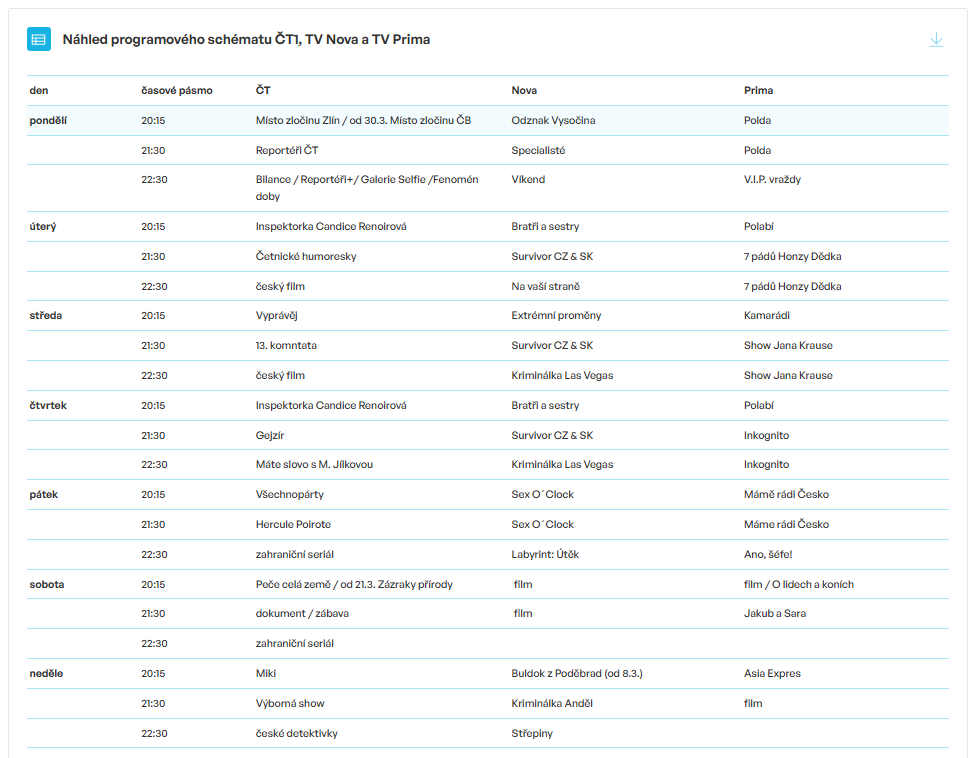
While Czech Television included its new programmes for the first half of the year at the beginning of January, commercial television stations saved the full launch of their spring programming schedules for the start of the commercial season at the end of February. They are gradually adding new premieres to their programming. The biggest battle between the newly launched titles will take place at the end of the week. TV Nova will pit the travel reality show Asia Express (starting on 1 March on TV Prima) against the series Buldok z Poděbrad. The light-hearted detective series starring Sabina Remundová, Max Dolanský and Marek Adamczyk will start a week later, on 8 March.

From the end of February, new episodes of reality shows will gradually appear in TV Nova’s programming schedule. Specifically, these are Survivor Czechia & Slovakia (from 24 February, three times a week) and, from the beginning of March, a new series of Extreme Makeover (Wednesday, 4 March). These will be complemented by the premiere of the series about children growing up, Sex O’Clock (Friday, 27 February), and at the end of the first week of March, the aforementioned series Buldok z Poděbrad.

On Monday evening, TV Nova will continue with the series Odznak Vysočina, and on Tuesday and Thursday with the series Bratři a sestry.

On Prima, the series Polabí continues on Tuesday and Thursday, Kamarádi on Wednesday, Máme rádi Česko on Friday, and a rerun of Polda on Monday.

From around mid-March, Saturday evenings on TV Prima should belong to the series O lidech a koních, starring Marek Lambora, which Prima only added to its Prima video platform last summer.

Another new addition to the afternoon schedule is the docu-reality show Nemocnice 24/7, set in an emergency room and based on real cases and diagnoses. It will be broadcast every weekday from 5 p.m. starting on 16 February.

Czech Television has already included most of its new programmes in its first channel’s schedule. The premiere of the detective series Místo zločinu Zlín will be replaced at the end of March by a rerun of the similar series Místo zločinu České Budějovice. Czech viewers will also be introduced to the premiere episodes of the Slovak miniseries Miki, inspired by the true story of Slovak underworld boss Mikuláš Černák. It will take over the Sunday evening slot after the Slovak series Neuer ends.

Source: mediaguru.cz

SPANISH COURT ORDERS NORDVPN AND PROTONVPN TO BLOCK LALIGA PIRATE STREAMS

LALIGA and Telefónica Audiovisual Digital (TAD) say they have judicial backing requiring NordVPN and ProtonVPN to prevent access from Spain to IP addresses where illegal transmissions of LaLiga matches have been verified. 

In a statement, the companies describe the precautionary measures from Commercial Court No. 1 of Córdoba as dynamic, with no right of appeal, allowing updated IP address lists to be supplied as new infringements are detected.

The court decisions also recognise VPN providers as “technological intermediaries” falling within the scope of the EU Digital Services Regulation, and therefore subject to requirements to help prevent infringements using their infrastructure. The orders describe VPNs as “highly effective and accessible” tools that can distort a user’s apparent location and facilitate access to websites carrying protected content illegally, noting the defendants “acknowledge and even advertise” their ability to evade restrictions.

LALIGA and TAD said the measures are intended to stop VPN services from contributing to the evasion of access restrictions already ordered by Spanish courts, referencing the December 2024 Barcelona Commercial Court No. 6 ruling that underpins LaLiga’s wider dynamic IP-blocking approach against piracy.

The court also orders also require LALIGA and TAD to preserve sufficient digital evidence of the unlawful transmissions they notify to the VPN providers, supporting the evidential approach used under previous rulings.

Source: broadbandtvnews.com

TRUST IN TV GREW FASTER OVER PAST FOUR YEARS THAN ANY OTHER MEDIUM, RESEARCH REVEALS

Following the launch of the Credos Trust Tracker data for 2025, Channel 4’s chief commercial officer analyses the results and their implications for TV advertising.

In a world of deepfakes, bots and post-truth politics, it’s not surprising that consumers are seeking shelter in trusted environments where accuracy is everything, and facts are back in fashion.

Regulation and verification have never been sexier. The BBC’s verify service is used by almost a quarter of UK adults, while the highly regulated public service broadcasters’ news reporting is consistently rated the most trusted.

Trust, then, is hard-won but increasingly valuable, as new research today makes clear.

The Advertising Association today (5 February) released new Credos Trust Tracker data for 2025. It shows that trust in ads continues to grow: 40% of people now trust the ads they come across.

While that’s great news for advertisers, agencies, and media owners, dig a little deeper and the story becomes more nuanced.

According to the data, trust in TV grew faster between 2021 and 2025 than in any other medium, including online and social media.

Of course, TV has long been seen as a trusted form of advertising – Thinkbox’s AdNormal study in 2021 concluded as such. But this latest research shows the gap is widening: 46% of respondents trust TV ads, 31% trust online ads, and 27% trust social media ads.

Moreover, TV is the most trusted medium among 18-34s (62% trust TV).

The data shows that familiarity with the brand and medium is a powerful driver of credibility and trust. Add to that the regulatory regime governing public service media, and we can see why trust in television advertising is high and, according to this research, has grown at nearly twice the rate of social media over the past four years.

The research also highlights that people who identify bombardment as an issue are the most likely to distrust advertising. You’ll recognise this phenomenon when purchasing online. Post purchase, you are literally the coldest lead in the world, but you’ll continue to receive ads for weeks to come. No wonder the research also shows that people who believe advertising is sufficiently regulated are much more likely to trust it.

That’s why, when we talk to advertisers and agencies, we tell them TV works

We can help marketers and agencies see beyond treating trust as a soft value and start treating it as a growth lever. Supporting them to move away from a fixation on cheap reach and short term optimisation and being far more deliberate about where brands show up, not just how efficiently they are delivered.

Sustainable growth will surely come from investing in quality, accountable media that audiences recognise as credible.

In practical terms, that requires advertisers, agencies, and media owners to rebalance investment toward regulated, transparent environments that have been proven to build long term brand effects, even if they appear less efficient in the short term. In other words, turn down the toxic, turn up the trust.

Some say there is a tension between the pressure to deliver growth and the responsibility that comes with scale. We do not think growth and responsibility are mutually exclusive or in opposition.

Both can and do go together. It appears there’s been an imbalance in spending, with more emphasis on growth amid economic pressures. Gradually, advertisers are finding that their brands are at risk of flattening as they prioritise short-term performance marketing.

My bet: trust will increasingly prompt a rethink as advertisers favour trusted environments like commercial public service media (TV), which are nutrient-rich, and nourishing – unlike dopamine-filled environments elsewhere.

Source: themedialeader.com

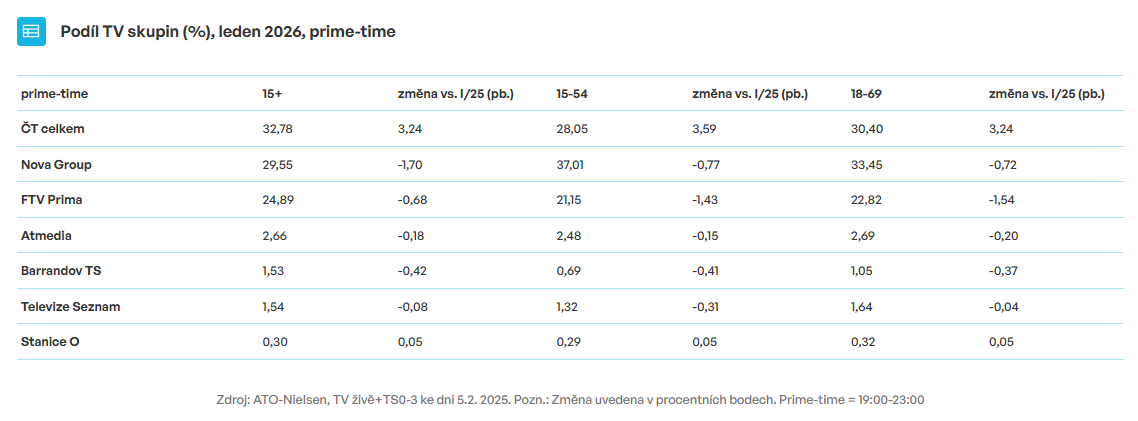
CZECH TELEVISION OUTPERFORMED COMMERCIAL STATIONS IN JANUARY AND CONFIRMED ITS LEADERSHIP

In January, Czech Television stations increased their share by three percentage points year-on-year and improved the most of all television groups in the overall results.

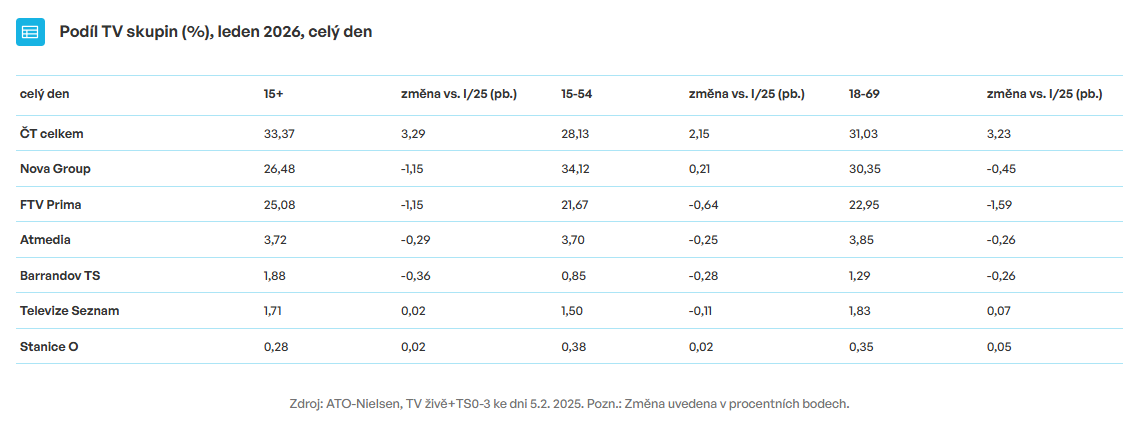
In January 2026, Czech Television stations recorded the highest audience share on the television market in the viewer group aged 15 and over in both all-day and prime-time broadcasting. The total share was 33.37%, up more than three percentage points year-on-year. ČT also achieved the highest viewership in the 18-69 viewer group throughout the day. This is according to official ATO-Nielsen television viewership data.

TV Nova continues to have the highest share in the 15-54 group in both all-day and prime-time broadcasting. It also had the highest share in the 18-69 group in evening broadcasting in January.

Overall, however, the major commercial television stations fell short of their January results from last year. The exception is the Nova group’s result in the 15-54 age group in all-day broadcasting, which was 0.2 percentage points higher than in January last year.

ČT24 was the month’s high flyer

Czech Television improved in January this year compared to the same month last year, mainly thanks to its four channels. The news channel ČT24 saw the most significant increase in its share to 5.58% (1.4 pb) in the 15+ audience group in all-day broadcasting. ČT2 also improved significantly, with its January share exceeding five per cent to 5.06% (0.8 pp), while the sports channel ČT sport increased its share by 0.65 pp to 4.01% and the main channel ČT1 also improved year-on-year, by 0.5 pp to 17.45%.

Of the other stations , CNN Prima News performed best , gaining 0.6 pp year-on-year and ending the first month of this year with a result of 2.80% (15).


Source: mediaguru.cz

CLOUDFLARE AND ONLINE PIRACY: THE RESPONSIBILITY OF DIGITAL INTERMEDIARIES UNDER SCRUTINY

The Tokyo District Court ruled that Cloudflare, one of the world’s leading Content Delivery Network (CDN) service providers, is liable for the manner in which it provides its services, which facilitates copyright infringement. The dispute concerned the illegal distribution of popular manga titles with a global reach, including the ONE PIECE and Attack on Titan series. The lawsuit was filed by four leading Japanese publishers – Kadokawa, Kodansha, Shueisha and Shogakukan.

The case dealt with the operation of two large pirate websites that illegally made more than 4,000 manga titles available. The sites recorded over 300 million visits per month and used Cloudflare’s CDN services, which enable fast and efficient content distribution while making it difficult to identify the original servers.

The court found that the company’s liability did not lie in the CDN technology itself, but in the manner in which it provided its services. In particular, it criticised the absence of thorough customer verification procedures (Know Your Customer – KYC) and the inadequate response to repeated notifications of copyright infringement.

According to the court, providing easy access to services without thorough client identification gave pirate website operators a high degree of anonymity. This significantly complicated the normal legal steps taken by copyright holders to protect their works.

Based on these conclusions, the court ruled out the possibility of using the so-called safe harbour under Japan’s Information Distribution Platform Safety Act. It concluded that the company was aware of the illegal nature of the activities that its services enabled and had the technical ability to terminate them. Cloudflare was therefore ordered to pay approximately 500 million yen.

The decision fits into the broader international debate on the liability of digital intermediaries. Similar issues are also addressed by European law – for example, the Digital Services Act and the Copyright Directive strengthen the obligations of platforms in the area of due diligence and cooperation and limit exemptions from liability in cases where the intermediary does not act passively or respond to obvious infringements of the law.

The company is also facing regulatory measures in Italy. The regulatory authority AGCOM recently imposed a fine of over EUR 14 million on the company for violating anti-piracy legislation (Law No. 93/2023). According to the authority, the company failed to comply with an order to block access to illegal content reported by the rights holder through the Piracy Shield system and did not take sufficient technological and organisational measures to prevent the further dissemination of such content.

This development confirms that even technology intermediaries can be held directly liable if they fail to respond to clear and timely requests to remove illegal content.

Source: previti.it

Privacy Overview

This website uses cookies so that we can provide you with the best user experience possible. Cookie information is stored in your browser and performs functions such as recognising you when you return to our website and helping our team to understand which sections of the website you find most interesting and useful.