OMDIA STUDY: PIRACY IN THE STREAMING ERA – MORE LEGAL CONTENT HAS NOT SOLVED THE PROBLEM

Better access to legal streaming services was expected to weaken piracy. The reality, however, has proved different. Omdia’s study Next-Generation Anti-Piracy for TV and Video: Why the streaming era demands a shift from reaction to prevention shows that more than one in five online adults use unauthorized video sources, with the share significantly higher among sports fans and the most engaged viewers. Piracy has also undergone a technological transformation: instead of complex solutions aimed at technically savvy users, illegal services increasingly offer convenience and a user experience approaching that of legitimate platforms.
Published by research and advisory firm Omdia in July 2026, the study examines one of the paradoxes of the past decade. The expansion of streaming was expected to remove one of the main drivers of piracy: content that was difficult to access or too expensive. The assumption was that if viewers could access films, TV series or sports quickly, conveniently and at an acceptable price, there would be little reason to seek out illegal alternatives. Omdia’s data, however, suggests that this assumption was overly optimistic.
The legal offering has expanded, but piracy has not disappeared
The availability of legal streaming services has indeed increased dramatically. By the end of 2025, Omdia was tracking more than 1,670 online video services across 148 countries, with more than 600 offering live sports coverage. Despite this exceptionally broad legal offering, piracy has not receded; according to Omdia, it appears to have continued growing in many countries. The sheer volume of legally available content has therefore not solved the problem on its own.
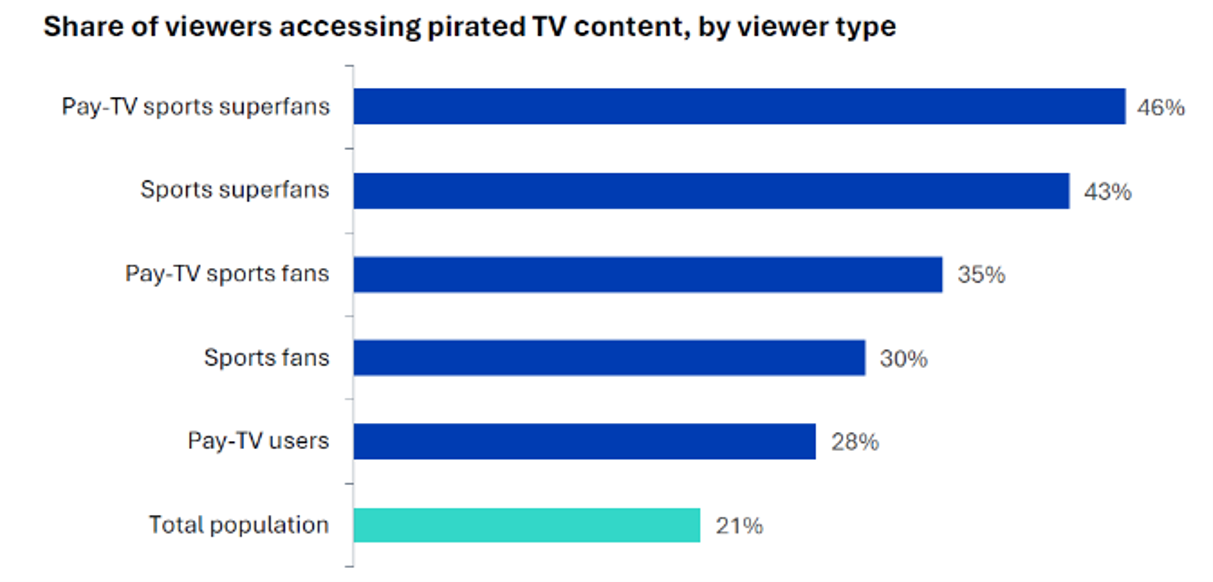
The scale of the issue is illustrated by a consumer survey conducted by Omdia in November 2025 among 21,806 people aged 18 to 64 across nine countries. Overall, 21% of online adults said they frequently stream or download video from unauthorized websites, apps or devices.
Piracy rates are highest among the most engaged viewers
The study records the highest levels of piracy among the most highly engaged audiences. Among sports superfans, 43% of respondents use pirated content, while the figure rises to 46% among pay-TV sports superfans. In other words, while roughly one in five people across the overall surveyed population use unauthorized video, the share approaches one in two among one of the most commercially valuable audience segments. Piracy is therefore not simply an issue involving viewers who are unwilling to pay for content; it also affects audiences with a strong interest in premium paid content.
image Source: Omdia
This creates a paradox: some of the most active consumers of illegal content are also among those with the strongest engagement with paid audiovisual content.
The study illustrates this trend even more clearly in the United States, one of the world’s most developed streaming markets. 29% of online adults report accessing pirated content, but among people aged 18 to 24, the figure rises to 41%. Among US pay-TV sports superfans, Omdia reports that the share exceeds 61%. Piracy is therefore not confined to consumers who refuse to pay for video. It significantly overlaps with audiences that already pay for content and are simultaneously among its most intensive consumers.
This generational dimension may have long-term implications. Younger audiences have grown up in an environment where they expect virtually immediate, on-demand access to content and, according to Omdia, have a low tolerance for friction and fragmentation in the legal streaming market. As this group gradually enters its peak earning and consumption years, the habits it forms today may influence the shape of piracy over the next decade.
Pirate services now compete not only on price, but also on convenience
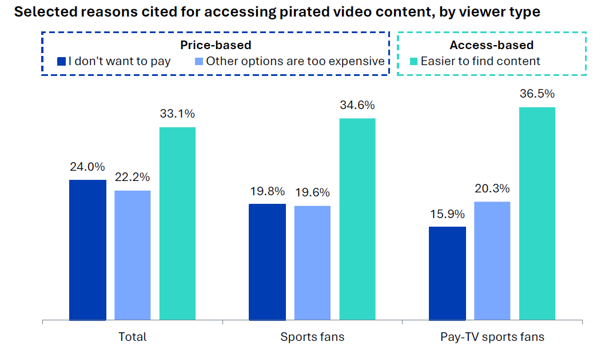
The motivations behind piracy are often oversimplified within the industry as simply “viewers do not want to pay.” According to Omdia’s data, however, the reality is much more complex. The most frequently cited reason for using unauthorized video was that content was easier to find. In a survey of 4,499 respondents who reported using unauthorized sources, 33.1% cited easier content discovery as a reason. By comparison, 24% said they did not want to pay for content, while 22.2% considered the available alternatives too expensive.
The difference is even more pronounced among sports audiences. Easier content discovery was cited by 34.6% of sports fans and 36.5% of pay-TV sports fans. By contrast, the proportion citing simple unwillingness to pay as the main reason fell to 19.8% and 15.9%, respectively. The study also notes that among sports superfans, nearly four in ten pirate viewers identify ease of access as their primary motivation. For legitimate providers, this is an uncomfortable finding: illegal services are competing not only on price, but also on the convenience with which users can access content.
image Source: Omdia
This also helps explain the apparent contradiction between the record number of legal services and the persistence of piracy. A larger number of platforms may mean a broader overall content offering, but fragmentation can also require viewers to determine which service holds the rights to a specific film, TV series or sports competition, manage multiple subscriptions and move between several different applications. The study specifically highlights younger viewers’ low tolerance for this fragmentation, while also showing that ease of finding content is one of the main advantages offered by unauthorized sources.
From hacked smart cards to smart-TV apps
It is not only consumer behaviour that has changed; the technology behind piracy has evolved as well. In the era of traditional pay television, piracy was to a large extent a hardware-based problem. Operators controlled the devices through which customers accessed content, making the security perimeter relatively well defined. Typical attacks included set-top-box manipulation, smart-card cloning or other forms of unauthorized access to broadcast signals. The emergence of new internet-based distribution technologies, however, created additional opportunities for abuse, making content protection more complex with every subsequent stage of technological development.
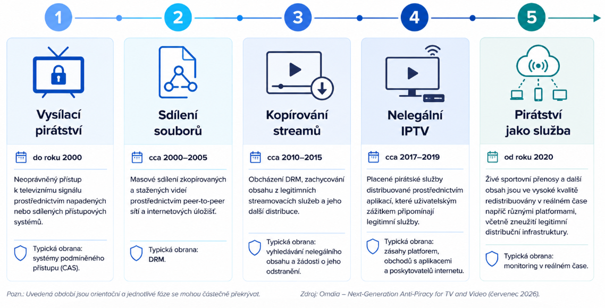
Omdia divides the evolution of piracy into several technological eras. Before 2000, a typical form of piracy involved obtaining unauthorized access to television broadcasts. Between approximately 2000 and 2005, the growth of the internet led to widespread file sharing through peer-to-peer networks and online storage services. Around 2010–2015, this was followed by DRM circumvention, transcoding and copying content from legitimate streaming services for redistribution. Towards the end of the 2010s, roughly 2017–2019, paid illegal IPTV services delivered through apps began gaining significant traction, increasingly resembling legitimate consumer products in the way they operated. The current phase, which began around 2020, is described by the study as “piracy as a service”. This means that content, particularly live sports and other events, is redistributed in real time and in high quality across multiple platforms.
image Source: Omdia
Connected TV (CTV) platforms and streaming applications have become central to this transformation. The same technology that made legitimate streaming services significantly easier for consumers to access has provided similar opportunities to illegal services. Omdia estimates that piracy through apps and devices now accounts for the majority—and a growing share—of unauthorized video consumption. The attack surface has therefore shifted from a limited number of operator-managed devices to a world of billions of devices over which content providers have no direct control.
“Streaming has transformed piracy from a hardware attack into a software-defined cybersecurity challenge.”
Rik Turner, Principal Analyst, Cybersecurity, Omdia
When a pirate service looks like a legitimate one
From the perspective of an ordinary viewer, this represents a major shift. According to Omdia, convenience, quality and an interface optimized for television screens have helped move piracy away from specialist websites and tools and closer to mainstream consumer behaviour. The study, for example, describes illegal IPTV as paid subscription services delivered through applications that provide a user experience similar to legitimate platforms. Convenience, quality and TV-friendly interfaces are therefore helping move piracy from the technological fringe into mainstream consumer behaviour.
This development also creates the conditions for one of the most problematic forms of modern piracy: unauthorized restreaming of live content. A sports broadcast or other live event can be redistributed in real time through pirate CTV services, specialist websites and apps, or social platforms. Time works against the rights holder. In the case of a film or television series, removing an illegal copy may still have value even after some delay. In the case of a football match, however, the value of enforcement drops dramatically after the final whistle. As the study points out, by the time a pirate stream is taken down, the match may already be over and its economic value to the rights holder may have been irretrievably lost.
Streaming did not defeat piracy. It helped change the rules of the game
According to the Omdia study, piracy has changed substantially since the rise of streaming services. What was once a largely hardware-oriented attack within relatively closed distribution systems has evolved into a software-based, cloud-based and multi-platform problem. And while pirated content once required a degree of technical knowledge and compromises in convenience, some illegal services can now compete with legitimate platforms in terms of user experience.
This also changes the question streaming providers need to ask themselves. It is no longer enough simply to consider whether legal content is affordable enough. The data suggests that it may be just as important to ask whether customers can easily find that content, gain access to it and watch it without unnecessary friction. At the same time, providers must contend with pirate distribution that uses the same ecosystem of applications, connected devices and internet infrastructure as legitimate streaming. Piracy is therefore becoming both a user-experience issue and a cybersecurity challenge.
About the study: Next-Generation Anti-Piracy for TV and Video: Why the streaming era demands a shift from reaction to prevention was published in July 2026 by technology research and advisory firm Omdia. It was authored by Rob Gallagher, Principal Analyst for Consumer Technology and Services, and Rik Turner, Principal Analyst for Cybersecurity. The study was commissioned by Verimatrix and, in addition to examining how piracy is evolving in the streaming era, explores why the authors believe traditional reactive content-protection tools increasingly need to be combined with preventive security mechanisms. The analysis draws on Omdia’s ongoing research across television and online video, digital content, consumer behaviour, cybersecurity and enterprise technology. The consumer data used in the study includes an online survey conducted in November 2025 among 21,806 people aged 18–64 in Australia, Brazil, France, Germany, Japan, Mexico, Spain, the United Kingdom and the United States. Data on the reasons for using unauthorized video services is based on responses from 4,499 respondents across the same nine countries.
Source: verimatrix.com