OMDIA STUDY: PIRACY IS NO LONGER JUST A SECURITY ISSUE — IT ALSO THREATENS THE PROFITABILITY OF STREAMING SERVICES

The television and streaming market continues to grow, but its economics are becoming increasingly strained. While the cost of premium content and sports rights remains high, market growth is being driven to an increasing extent by streaming models that generate lower revenue per viewer. The Omdia study Next-Generation Anti-Piracy for TV and Video: Why the streaming era demands a shift from reaction to prevention therefore warns that piracy can no longer be viewed solely as a technical or legal issue. It is having an increasingly significant impact on revenues, operating costs and the return on investment in content.
Published by research firm Omdia in July 2026, the study examines piracy in the context of the broader transformation of the economics of the television and online video market. On the one hand, service providers must finance expensive programming and premium rights; on the other, they face pressure on profitability and changes in the revenue mix. According to Omdia, it is precisely in this environment that the role of content protection is changing, moving from a supporting security function to a strategic business priority.
The economic dimension of the problem is further amplified by the profile of those consuming pirated content. Omdia points out that nearly half of the highest-spending and most engaged viewers are also among the most active consumers of pirated content. Piracy therefore has a significant impact even on audiences that are of exceptional commercial value to service providers.
The market is growing, but the revenue mix is changing
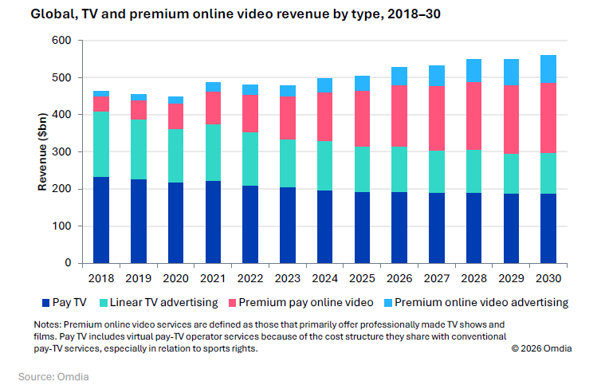
At first glance, the outlook for the industry appears relatively positive. Omdia forecasts that global television and premium online video revenues will increase from approximately USD 504 billion in 2025 to more than USD 560 billion in 2030. However, growth in the market’s overall value does not tell the whole story. It is equally important to consider where the new revenue is coming from.
According to the study, pay-TV subscription revenues and linear television advertising revenues are declining. Growth is increasingly concentrated in ad-supported streaming tiers and other online video formats, which on average generate lower revenue per viewer. The overall market can therefore continue to grow even though part of that growth comes from business models that generate less revenue per user.
The chart below shows the development of global television and premium online video revenues between 2018 and 2030, broken down into pay TV, linear TV advertising, paid premium online video and premium online video advertising.
Source: Omdia
These changes are highly relevant to the discussion around piracy. In addition to pursuing further growth, service providers are placing increasing emphasis on profitability and on their ability to monetize audiences effectively. Protecting content revenues is therefore becoming increasingly important at a time when the economics of the entire industry are under growing pressure.
Premium content still comes at a high cost
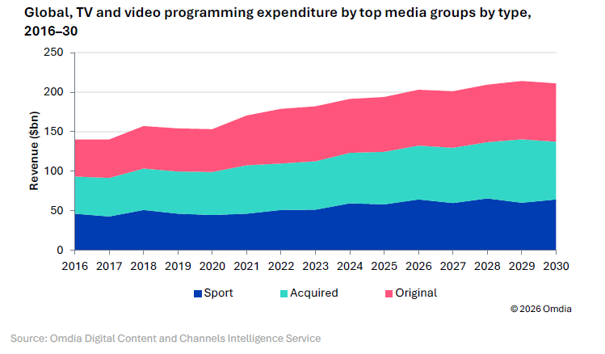
Costs, meanwhile, continue to rise. Omdia expects content spending by major media groups to reach a record USD 203 billion in 2026 and increase to USD 211 billion by 2030. Of that amount, rights to live sports alone are expected to account for USD 73 billion in 2030.
This creates a challenging combination for providers: the content they need to attract and retain viewers remains extremely expensive, while an increasing share of revenues is being generated in an environment with lower revenue per user. Piracy is therefore not only a question of content ownership, but also of whether multibillion-dollar investments in that content can generate an adequate return.
Source: Omdia
The chart shows global television and video content spending by leading media groups between 2016 and 2030, broken down into sports, acquired content and original productions. Together with the previous chart, it clearly illustrates the fundamental economic pressure facing the industry: the revenue mix is changing, while content costs remain high.
Sports are exceptionally valuable — and expensive
According to Omdia, the high level of spending on sports rights has a clear economic rationale. Sports help attract new subscribers and reduce churn. Because most sports coverage is watched live, it can also bring together a mass audience at a single moment, making it exceptionally valuable for advertising and sponsorship.
The development of sports rights prices is not uniform across all countries — growth is slowing in some markets while accelerating in others — but sports remain one of the most significant budget items for operators. This makes the impact of live sports piracy particularly acute: it affects content in which providers invest exceptionally large sums with the expectation that it will attract new subscribers and generate advertising and sponsorship revenue.
With live sports, minutes matter
Omdia identifies live restreaming as one of the defining threats of the current era of piracy. Live content is illegally redistributed in real time through pirate CTV services, social platforms, dedicated websites and apps. According to the study, this is where the financial risk is highest and where the scope for reactive intervention is most limited. By the time a takedown request for an illegal stream is issued, the match may already be over and the associated revenue lost. In this context, piracy affects the product precisely at the moment when it has the greatest commercial value to the rights holder.
When the operator also bears the cost of the pirate stream
The study illustrates the economic impact even more clearly using the example of abuse of a legitimate provider’s distribution infrastructure, known as CDN leeching. Attackers can obtain stolen access tokens from legitimate applications and use them to pull the stream directly from the operator’s network. As a result, content may be delivered to non-paying viewers through the same infrastructure that the provider finances for its legitimate customers.
According to Omdia, this type of abuse has a threefold impact. First, it increases the operator’s data delivery costs, as the provider is effectively paying to distribute content to non-paying viewers precisely during periods of peak demand. Second, the additional load may degrade service quality for legitimate subscribers. Third, it reduces the return on investment in premium content. Piracy therefore not only lowers the return on investment in premium content, but can also directly increase operating costs.
Content protection is moving from IT into strategic management
According to Omdia, the growing economic significance of piracy is also reflected in the priorities of media companies themselves. More than half of technology executives at television, film, sports and online video providers consider content protection — including technologies and measures such as digital watermarking, anti-piracy tools, application security and controls designed to limit unauthorized credential sharing — to be a highly significant business challenge.
Content protection is therefore moving onto a similar level of importance as other major issues facing the media industry, such as the adoption of artificial intelligence, cloud migration and the convergence of traditional television broadcasting and streaming. Its role is changing: it is no longer simply about securing content delivery, but increasingly about protecting revenue, content investment and the economics of the service itself.
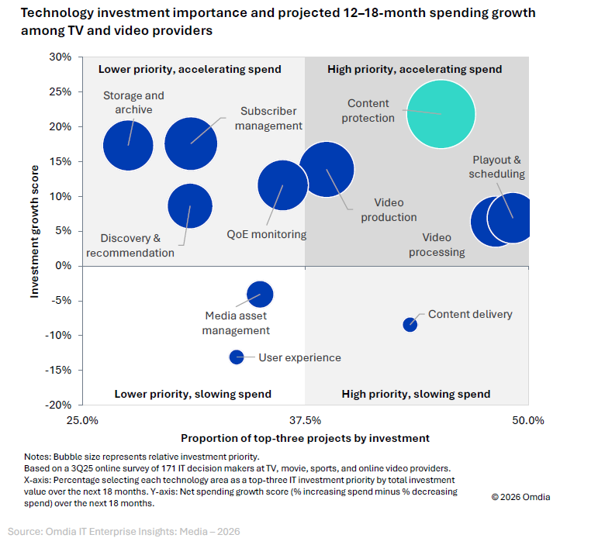
This shift is also reflected in investment plans. In a survey of 171 IT decision-makers at television, film, sports and online video providers, Omdia examined technology priorities and expected spending trends over the following 12 to 18 months. In this comparison, content protection ranks among the areas with both a high investment priority and growing expenditure. In terms of investment momentum, it ranks ahead of areas such as user experience, subscriber management, and content discovery and recommendation systems.
Source: Omdia
The chart shows that content protection is both a high-priority investment area and one in which providers expect spending to continue to increase.
Content protection is becoming part of investment protection
Against a backdrop of rising content costs, pressure on margins and pirate services that can now compete even in terms of user experience, perceptions of security are also changing. If content protection is viewed merely as a technical cost item, its business value can easily be overlooked. Omdia, however, takes a different view: content protection is increasingly also about protecting the revenue and the investment in the product for which the operator has paid.
Omdia therefore recommends that television and online video service providers treat content protection as a strategic priority. According to the study, underinvestment in this area carries the risk of losing not only revenue, but also the viewers whom investments in premium content were intended to attract and retain. From this perspective, combating piracy is no longer simply a matter of securing content; it is also about protecting the service’s business model.
According to the study, reactive measures alone are no longer sufficient. Modern piracy can exploit their limitations, and particularly in the case of live content, reactive intervention often comes too late. If revenue protection is to be truly effective, part of the defensive strategy must shift from identifying and removing illegal content after the fact to prevention — in other words, preventing attackers from obtaining the content in the first place and subsequently redistributing it. This shift from reaction to prevention will be the focus of the third part of the series.
About the study: Next-Generation Anti-Piracy for TV and Video: Why the streaming era demands a shift from reaction to prevention was published in July 2026 by research firm Omdia. Its authors are Rob Gallagher, Principal Analyst for Consumer Technology and Services, and Rik Turner, Principal Analyst for Cybersecurity. The study was commissioned by Verimatrix and, in addition to examining the transformation of piracy in the streaming era, explores why the authors believe traditional reactive content protection tools increasingly need to be combined with preventive security mechanisms. The analysis draws on Omdia’s ongoing research into television and online video, digital content, consumer behaviour, cybersecurity and enterprise technology. The consumer data used in the study includes, among other sources, an online survey conducted in November 2025 among 21,806 people aged 18–64 in Australia, Brazil, France, Germany, Japan, Mexico, Spain, the United Kingdom and the United States. Data on the reasons for using unauthorized video services is based on responses from 4,499 respondents across the same nine countries.
Source: verimatrix.com