NEARLY ONE IN THREE UK ADULTS USE ILLEGAL STREAMING, WITH FILMS AND TV SHOWS MORE POPULAR THAN SPORT

- Nelegální streaming využívá téměř třetina dospělých Britů, nejčastěji mladí lidé
- Filmy a pořady pirátí více diváků než sportovní přenosy
- Sociální sítě jsou nejčastější cestou k nelegálnímu obsahu
- Pirátské zdroje častěji využívají domácnosti s malými dětmi
Illegal streaming of films, television series and live sports is more widespread in the UK than might be expected. According to a new study by WPI Economics, nearly one in three UK adults use illegal streaming services, with the figure rising to more than half among young adults. The research also reveals that digital piracy is far from being limited to sports fans. Social media, content pricing and viewing convenience all play significant roles in shaping consumer behaviour.
The scale of illegal streaming in the UK and the behaviour of its users are explored in detail in the British study The Price of Piracy: Hidden Costs of Illegal Streaming to the UK Economy. Its findings reveal significant differences in viewing habits depending on age, household composition, the type of content people seek and the methods they use to access it. The research also highlights an interesting gap between viewers' attitudes and their actual behaviour. Some users consider piracy ethically wrong, yet have no intention of giving it up.
Nearly One in Three UK Adults Stream Content Illegally
According to the survey, 31% of UK adults had accessed content through illegal sources during the previous three months. A total of 27% of respondents used these sources to watch films and television programmes, while 18% accessed live sports broadcasts. These groups overlap to some extent, as some respondents illegally stream both types of content. The study's authors also estimate that approximately 16.8 million people in the UK use illegal streaming.
For most of these users, illegal streaming is not an occasional activity. 76% of active illegal streamers access pirated content at least once a month, while almost half (46%) do so every week. For a substantial proportion of users, illegal streaming has therefore become a regular part of their audiovisual content consumption.
The researchers adopted a relatively broad definition of piracy. It included watching films, television programmes and live sports through unofficial websites, file-sharing and torrent services, streaming devices used to access unauthorised sources, and social media platforms. The definition also covered the use of VPNs to access content available exclusively in other countries.
Illegal Streaming Is Most Widespread Among Young Adults
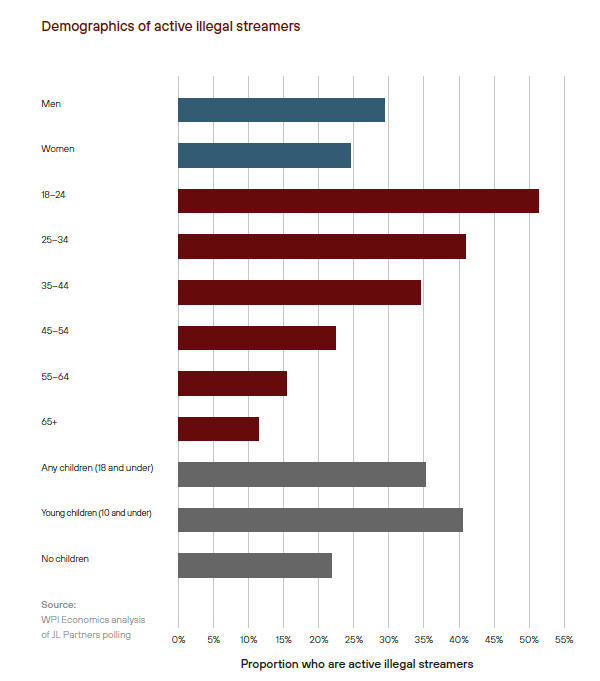
Illegal streaming is most prevalent among younger adults. In the 18–24 age group, 51% of respondents reported using illegal sources. According to the study's chart, the figure stands at approximately 40% among those aged 25–34 and around 35% among people aged 35–44. Among those aged 45–54, the proportion falls to approximately 22%.
The prevalence of illegal streaming declines significantly with age, dropping to 15% among people aged 55–64 and just 11% among those aged 65 and over.
The research also identified an interesting relationship between illegal streaming habits and household composition. In households with children under the age of ten, 40% of respondents reported watching content illegally, compared with just 23% in households without children. The study's chart also indicates that approximately 35% of respondents living in households with children under 18 used illegal streaming services.
These findings suggest a correlation between the presence of children in a household and greater use of unauthorised content sources, although the research does not establish the underlying reasons for this relationship.
More People Illegally Stream Films and TV Shows Than Live Sports
Although piracy is often associated primarily with unauthorised broadcasts of sporting events, the UK survey paints a somewhat different picture. 88% of active illegal streamers watch films and television programmes through unauthorised sources, while 60% illegally stream live sports.
Looking at individual content categories, 72% of illegal streamers watch television programmes and 69% watch films. These categories overlap, as individual viewers may consume multiple types of content.
Among those who illegally stream television programmes, drama is the most popular genre, watched by 56% of respondents in this group. Comedy and entertainment programmes follow at 52%, while reality television accounts for 34% and documentaries for 32%.
These findings demonstrate that digital piracy affects a broad range of television content, rather than being confined to blockbuster films or exclusive sporting events.
Significant differences also emerge between male and female viewers. Among women who use illegal streaming sources, 62% watch drama content, compared with 44% of men in the same category. The pattern is reversed for sport: 63% of male illegal streamers report watching sports content through unauthorised sources, compared with just 26% of female illegal streamers.
When it comes to individual sports, football is by far the most popular, watched by 91% of illegal sports streamers. Boxing follows at a considerable distance with 40%, Formula 1 with 36% and tennis with 34%.
Football also maintains its dominant position when legal viewers are included in the comparison, reaching 88%, compared with 37% for Formula 1 and 34% for boxing.
Similar preferences are evident among the wider viewing public, including those who access content exclusively through legal sources. Within this broader group, films are the most popular category (68%), followed by drama (60%) and comedy and entertainment programmes (51%).
The findings therefore suggest that the content preferences of illegal streamers are, in many respects, similar to those of the general viewing audience.

Social Media Is the Most Common Route to Pirated Content
The analysis of how viewers access pirated content also produced some surprising results. The most common route is not dedicated piracy websites or modified streaming devices, but social media platforms.
54% of active illegal streamers access unauthorised content through social media. By comparison, 28% use unofficial websites to stream or download content, while 26% access pirated material through purchased devices or illegal subscription services.
Less common methods include downloading content via torrents or cloud-based file-sharing services, used by 15% of illegal streamers, and illegally purchasing login credentials or passwords for legitimate services, reported by 7%.
These methods may overlap, as users are not necessarily limited to a single way of accessing unauthorised content.
The study's authors highlight an important distinction in how different forms of piracy are perceived. Accessing content through modified devices or paid unofficial IPTV services may appear more obviously questionable to users.
By contrast, watching unauthorised content on social media closely resembles ordinary everyday online behaviour. As a result, viewers may not always realise that they are accessing pirated content through these platforms.
Even Some Illegal Streamers Believe Piracy Is Wrong
The research examined not only viewing habits but also attitudes towards illegal streaming. Among people who do not use illegal streaming services, 73% consider piracy ethically wrong. However, 42% of active illegal streamers share the same view.
This suggests that a significant proportion of people using pirated content recognise the ethical concerns surrounding their behaviour, yet continue to engage in it.
Price is one of the most important factors influencing illegal streaming behaviour. Among the reasons given for accessing pirated content, the most common is the financial advantage of illegal sources over legitimate alternatives, cited by 38% of illegal streamers.
A further 31% justify their behaviour on the grounds of convenience, while 24% cite the desire to avoid subscription fees and 15% point to the limited availability of certain types of content in the UK.
These responses show that saving money is not the only motivation. Ease of use and access to desired content also play important roles in shaping viewing choices.
For some viewers, illegal alternatives may therefore be attractive not only because they are cheaper, but also because they appear simpler or more accessible than legitimate streaming services.

The gap between personal beliefs and actual behaviour is further illustrated by another finding. More than half of the 42% of illegal streamers who personally consider piracy ethically wrong nevertheless say they are likely to continue doing it.
Believing that illegal streaming is wrong does not necessarily translate into a willingness to change viewing habits.
Overall, the UK study portrays digital piracy as a widespread and regularly used means of accessing audiovisual content. While it is particularly prevalent among younger audiences, it is by no means limited to them.
The findings also suggest that efforts to reduce illegal streaming cannot rely solely on moral arguments. Consumer behaviour is also shaped by content pricing, availability and the convenience offered by different viewing options.
About the study: The Price of Piracy: Hidden Costs of Illegal Streaming to the UK Economy was produced by UK consultancy WPI Economics in association with the BeStreamWise initiative. The report examines the scale and nature of illegal streaming of films, television programmes and live sports in the UK, its economic consequences, the risks it poses to viewers and potential measures to tackle digital piracy. The study draws, among other sources, on a survey conducted by JL Partners among 2,501 respondents between 3 and 11 February 2026. In addition to the survey findings, it uses statistical and specialist sources, together with economic modelling, to estimate the financial and wider economic impact of piracy.
Source: The Price of Pirac