The Association of Commercial Television is a self-regulatory body registered with 

What is self-regulation
Self-regulation in the media environment represents the voluntary adoption of rules by broadcasters and media service providers for the purpose of cultivating and responsibly developing their services. The Association of Commercial Television is a self-regulatory body for the below-mentioned areas of the media environment – for the area of program labeling and for the purposes of implementing the European Media Freedom Act (EMFA).
Generally, a self-regulatory body is established in accordance with the legal regulations of the Czech Republic, including regulations binding for the Czech Republic from European Union legislation (such as Act No. 231/2001 Coll., as amended, or the EU EMFA regulation). Detailed information about self-regulation is also available on the website rrtv.gov.cz.
Any questions, suggestions, or complaints on this topic can be submitted through this contact form or sent to the ACTV registered office address or via data box.
European Media Freedom Act (EMFA)
The Association of Commercial Television is a self-regulatory body for the purposes of implementing the European Media Freedom Act (EMFA). Specifically, it is a signatory to the Ten Principles for Individual Media Service Providers serving to implement EMFA. The EMFA regulation brings a number of tools for protecting freedom, plurality, and editorial independence of media throughout the European Union. To fulfill the requirements of this regulation in the area of self-regulation, an agreement was reached on the so-called Ten Principles for Individual Media Service Providers. Its form is based on the principle supporting media freedom while maintaining a high level of transparency and accountability to the public.
Program Labeling
The Association of Commercial Television is also a self-regulatory body in the area of program labeling (informing viewers about potentially inappropriate content and viewing suitability according to age categories). ACTV members approach self-regulation in their own interest, for this purpose they commit in writing to comply with the rules set out in the Code of Rules for Program Labeling.
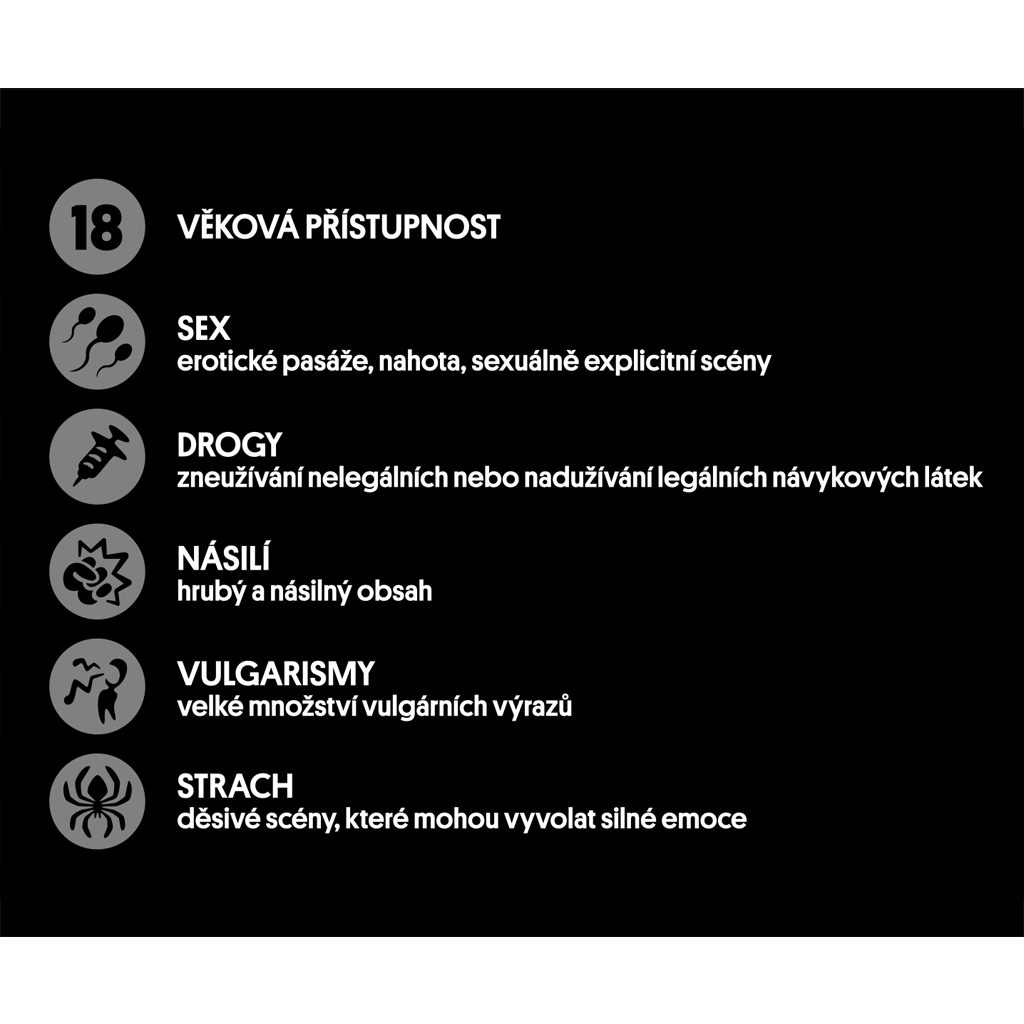
Program labeling serves to clearly mark broadcast works, series, and films in terms of potentially harmful content and viewing suitability according to the viewer’s age. The law requires graphic marking of “18+” for content unsuitable for minors. In addition to the “18+” symbol, simple pictograms also help with orientation, providing additional information about the specific type of potentially harmful content. The inspiration for the labeling system came primarily from the Dutch Kijkwijzer model, which is considered the most sophisticated in Europe.
There are fundamental cultural differences between individual territories in the world; for example, in Europe there is greater tolerance for nudity and less tolerance for graphic violence. While in the USA they have a stricter measure for nudity and are more lenient toward graphic violence. Therefore, program labeling cannot be taken directly from distributors. For this reason, a joint project of ACTV members was created under the auspices of ACTV for the purpose of standardized assessment of program harmfulness – a unified database that divides programs into categories.
Labeling of risky content includes these categories:
- pornography,
- graphic gratuitous violence,
- violence,
- fear and horror,
- alcohol and drugs,
- sex and vulgarisms.
If the evaluated program contains an element of pornography or graphic gratuitous violence, the program is completely excluded from broadcast. According to the degree and context of portrayal of other monitored categories of potentially threatening content, the program is assigned an accessibility label from 4, 8, or 15 years. The dramaturg is responsible for the final classification of the program.
Examples of Potentially Harmful Content Labeling
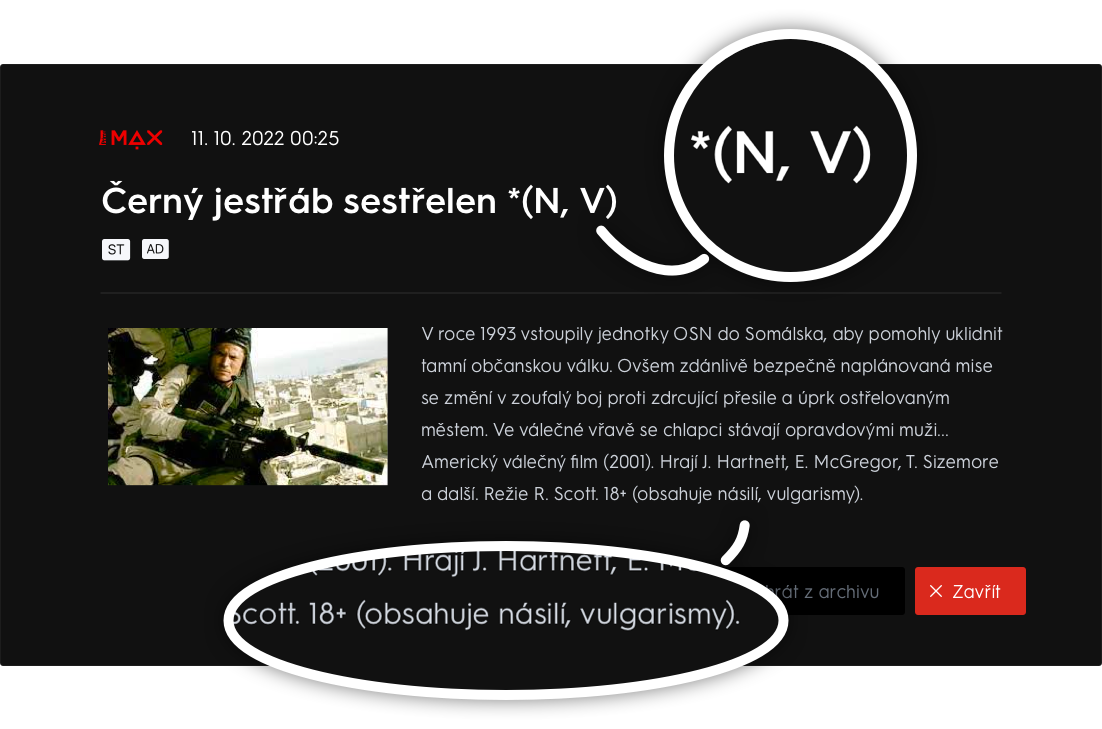
Program labeling specifies and supplements information about the nature of the potential harmfulness of the program. Simple labels are displayed in two possible forms, textually or graphically:
- after the program description: “18+ (Fear, Violence, Vulgarisms, Sex, Drugs)
- in abbreviations: “*(F,V,Vu,X,D)” on screen in EPG (Electronic Program Guide) next to the program name
The criterion for scheduling programs for broadcast and labeling potential harmfulness is whether the programs could seriously impair the physical, psychological, or moral development of minors. Program labeling is ensured through self-regulation, meaning that if a program could be inappropriate, program staff mark it with an 18+ age recommendation including harmful elements and the program is scheduled for broadcast after 10 PM. The 18+ label is then visible on screen throughout the entire broadcast. In the internal program database of individual television stations, there is also a large number of programs for which two broadcast versions are available. One is intended for broadcasting after 10 PM and the other for daytime broadcasting, where potentially harmful scenes are edited.
Example of program labeling on TV Prima channels.
Example of program labeling on TV Nova channels.
Pictograms for program labeling on TV Óčko.
Labels for Hearing
and Visually Impaired
Similarly to programs with potentially harmful content, abbreviations for hearing or visually impaired viewers are also indicated in TV broadcasts and program guides.
ST Label: If this label is indicated for a program, then it is possible to turn on Subtitles for the hearing impaired in the TV settings.
AD Label: Audio Description, i.e., audio descriptive narration of visual events for viewers with visual impairment, can be turned on and the volume can be independently regulated in the TV menu.